Quick Navigation
- The Cheese Trail in One View
- Grimbister Cheese: Orkney's Living Tradition
- The Seator family at Grimbister Farm
- What makes Grimbister different
- Where to buy Grimbister
- Tasting notes and how to eat it
- Orkney Cheese Company: From Nissen Hut to Extra Mature Cheddar
- Westray Wife and the Burnside Revival
- Tasting Notes and How to Read Each Cheese
- Where to Buy Orkney Cheese
- Specialist delis
- Butchers and farm shops
- The Farmers' Market
- Direct from the farm
- Pairing Orkney Cheese: Bannocks, Whisky, Honey
- Frequently Asked Questions
- What makes Grimbister cheese different?
- Where is the best place to buy Orkney cheese?
- Can you visit the Orkney cheese farms or dairies?
- Is Orkney cheddar vegetarian?
- Are Wilsons of Westray still making cheese?
- Sources & further reading
Orkney's cheese story isn't a tasting room with a velvet rope. It's a creamery that began in 1946 in an ex-RAF Nissen hut just outside Kirkwall — now on Crowness Road — pressing cheddar to a recipe tweaked once, decisively, in 1958; it's Anne Seator at Grimbister Farm in Firth making the kind of fresh, lemony crumbled cheese her mother Hilda first made there; it's a Stromness deli slicing what is, on a good Saturday, half the islands' cheese on a paper-wrapped board. Four small producers, three parishes, and an evening cheeseboard that will quietly out-class anything you've eaten in London.
The Cheese Trail in One View
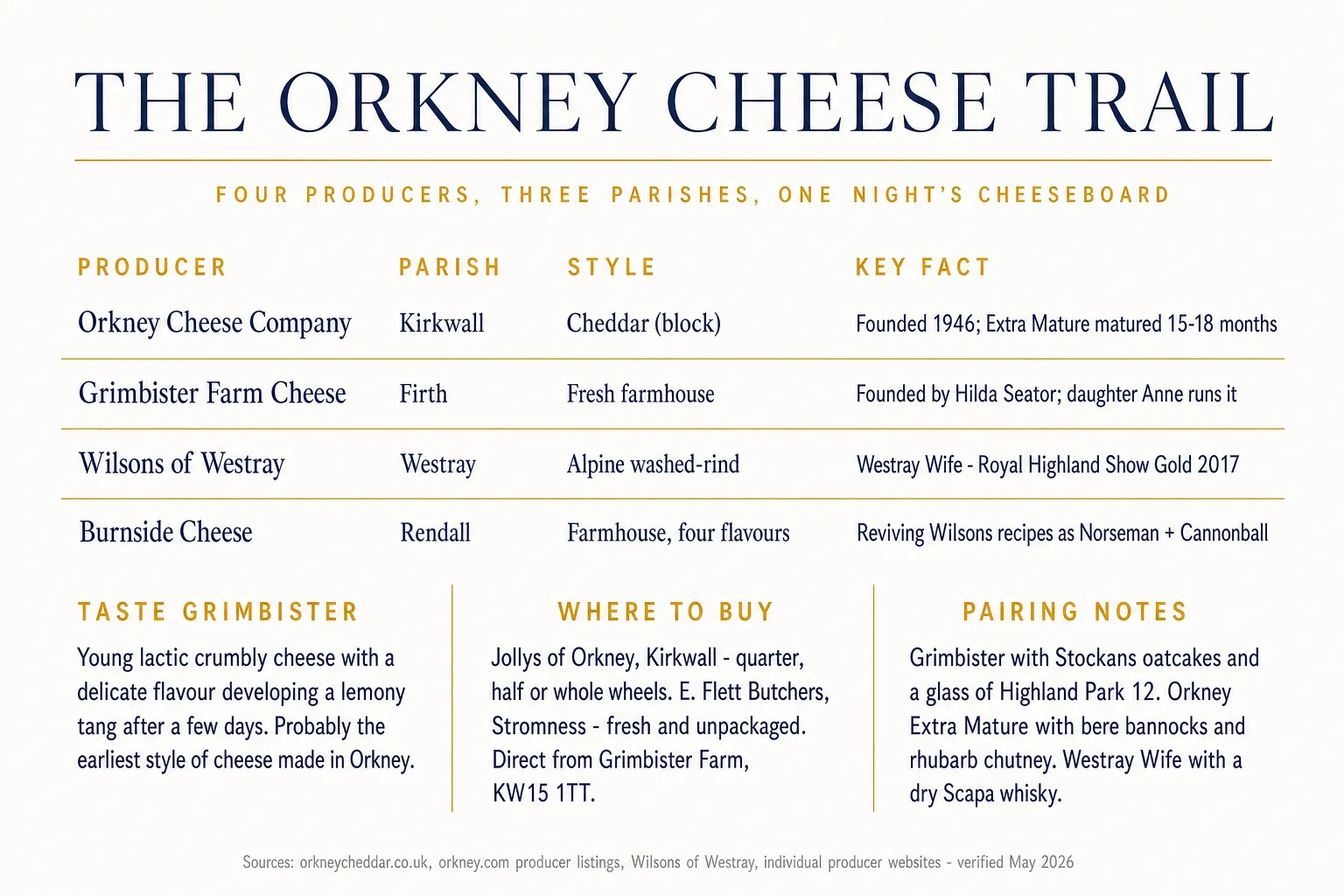
Orkney has fewer producers than Speyside has distilleries, but the four below cover every style you need on a serious cheeseboard — fresh, washed-rind, mature cheddar, and farmhouse. The same data is shown in the directory below.
| Producer | Where | Cheese & style |
|---|---|---|
| Grimbister Farm Cheese | Firth (Seator family) | Fresh, lightly pressed farmhouse cheese — Orkney's oldest style |
| Orkney Cheese Company | Kirkwall (est. 1946) | Orkney Extra Mature Cheddar, matured 15–18 months |
| Burnside Cheese | Rendall (Barry Graham) | Four-flavour farmhouse range, plus revived Norseman & Cannonball |
| Wilsons of Westray | Westray | Westray Wife alpine washed-rind — on pause since spring 2024 |
Grimbister Cheese: Orkney's Living Tradition
Of every cheese on this trail, Grimbister is the one that connects you to the deepest part of the Orkney larder. Grimbister is "probably the earliest cheese made in Orkney" — a fresh, lightly pressed farmhouse style that predates industrial cheddar by generations and is, as far as anyone can trace, the most authentically Orcadian cheese still made for sale today. The farm is at Grimbister, in the parish of Firth, just east of Finstown on the road in from Kirkwall (postcode KW15 1TT), where the bay opens out and the green dairy fields run down to the water.
The Seator family at Grimbister Farm
The cheese-making business was founded by Hilda Seator, who turned the surplus milk from the family's small Friesian herd into a fresh farmhouse cheese using a closely-guarded family recipe. Hilda's daughter Anne Seator now runs Grimbister, and the cheese has quietly travelled out from the farm gate onto fine-food wholesale lists and restaurant cheeseboards across the UK. The herd is still small; the cheese is still made on the farm; the recipe is unchanged. There is no visitor centre, no tasting room, no gift shop — just a working dairy farm in Firth where the cheese goes out the door to delis the same week it's made.
What makes Grimbister different
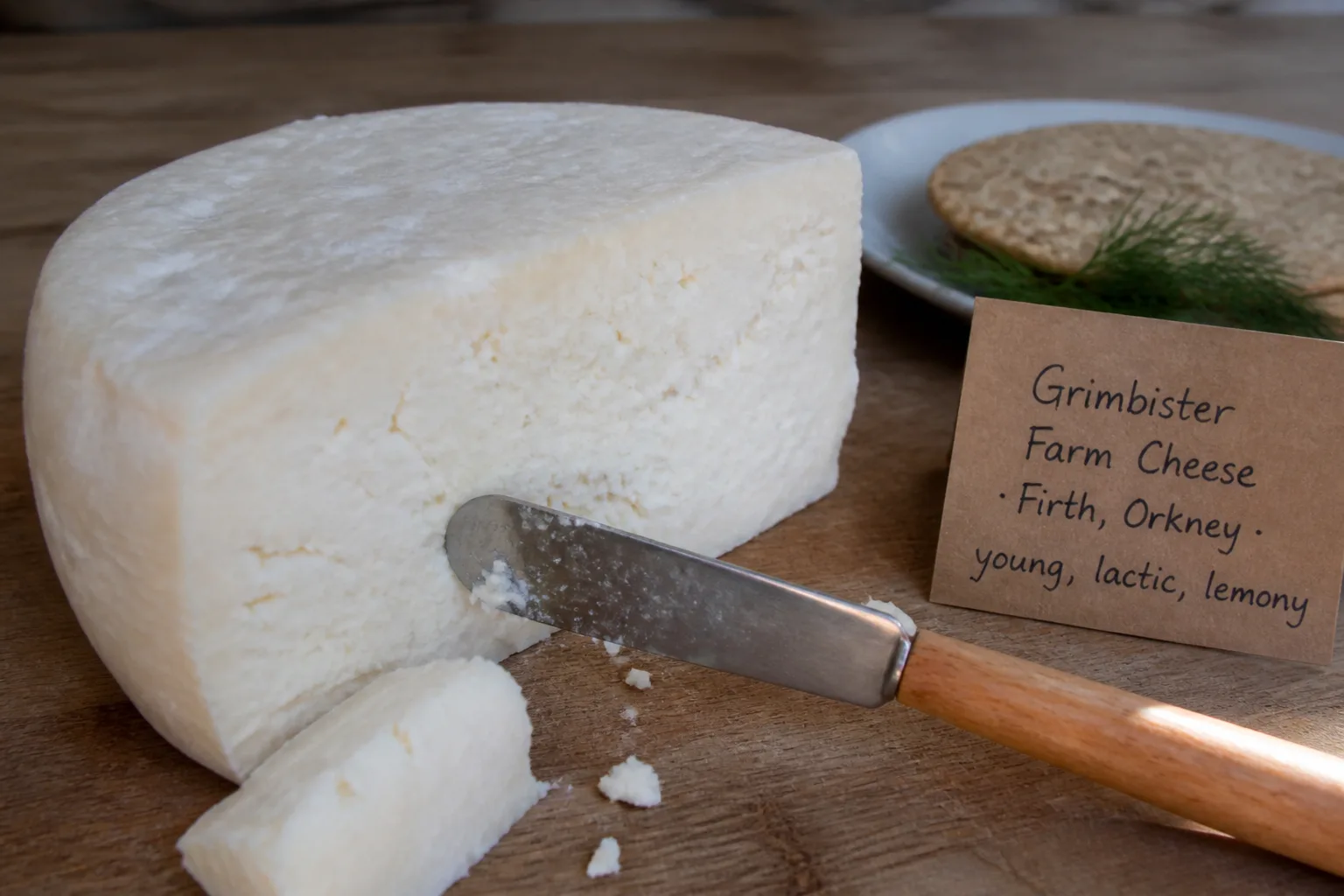
Grimbister is a young lactic crumbly cheese — fresh, pale, almost paneer-textured to look at. The producer's own description is exact: "young, lactic, crumbly" with "a delicate flavour when new, developing a lemony tang after a few days." It is not aged. It is not pressed hard. It belongs in the same broad family as a young Caerphilly or a Lancashire crumbly, but the milk is Orcadian and the recipe is its own. Eat a wedge fresh and it is mild, almost sweet; leave it three or four days in the fridge and the citrus note appears — that's the cheese telling you what it can do.
Where to buy Grimbister
Tasting notes and how to eat it
Treat Grimbister like a young farmhouse, not a hard cheese. Crumble it onto a warm bere bannock; pair it with Orkney heather honey and a glass of dry Highland Park 12; or eat it the local way — fresh, with a slice of rhubarb chutney and an oatcake. Some Orcadian families fry slices of Grimbister briefly in butter until they squeak; it doesn't melt the way a cheddar does, which is part of its appeal. If you only buy one Orkney cheese on your trip, this is the one a Stromness deli owner will tell you to take.
Planning your trip
Staying overnight? Compare live prices and availability across Orkney on Booking.com.
Compare Orkney staysWe earn a small commission if you book through this link, at no extra cost to you.
Orkney Cheese Company: From Nissen Hut to Extra Mature Cheddar
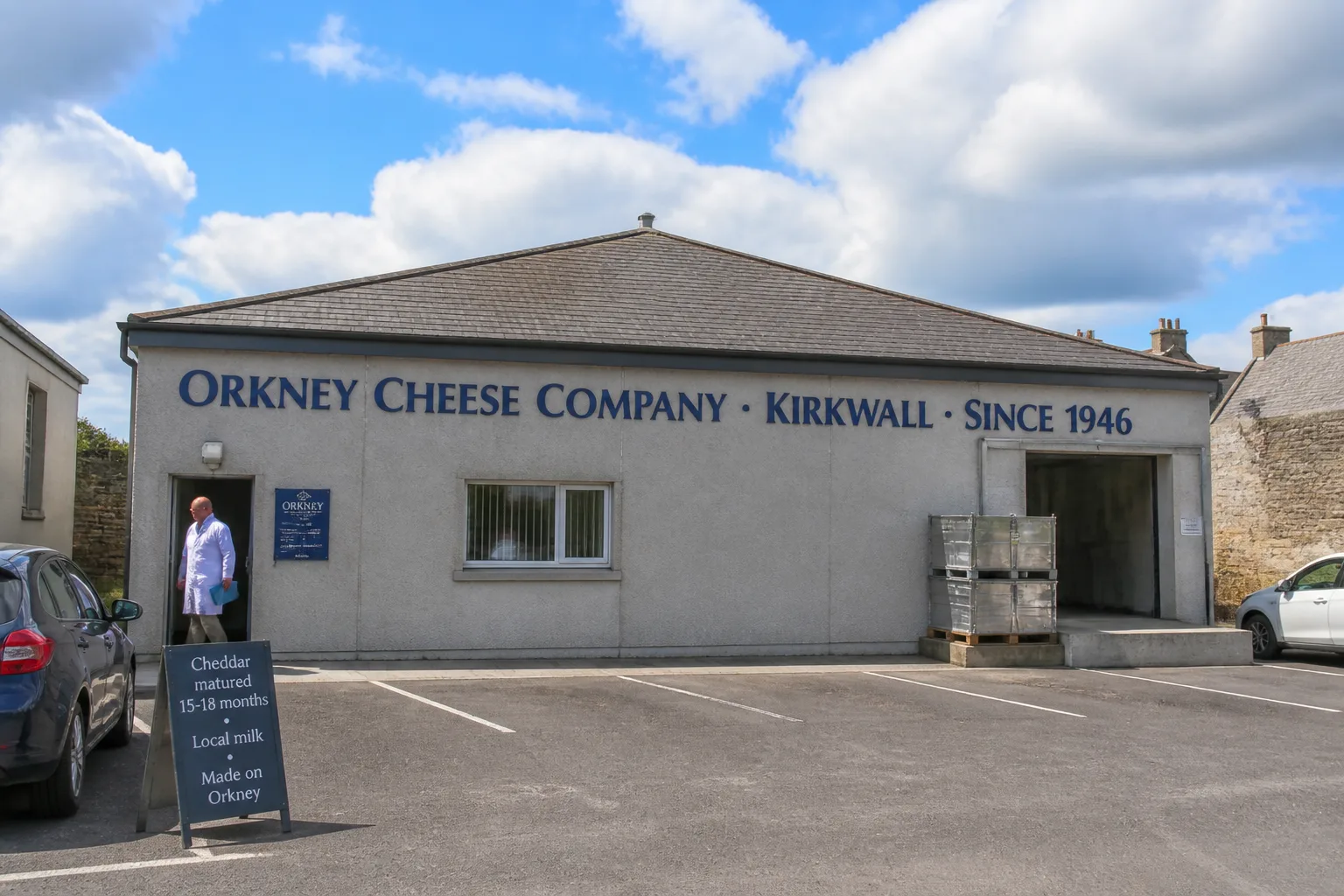
Drive five minutes out of Kirkwall along Crowness Road and you'll pass a low industrial building that doesn't shout about itself. This is the Orkney Cheese Company, and it has been pressing cheese on essentially the same spot since 1946 — when the creamery was first set up in a Nissen hut from a former RAF camp just outside town. Post-war milk surpluses needed somewhere to go; the cheese factory was the answer. The original product was a hard cheese in traditional clothed cylinders, blocks and wheels; in 1958 the recipe switched to cheddar, and in 1984 the company introduced what they still call their "dry stir technique" — a small mechanical change that gives the modern Orkney cheddar its distinctive crystalline crunch on the finish.
In 2001 the creamery moved to its current, purpose-built site on Crowness Road. The milk still comes from Kirkwall-area dairy farms; the cheese is still pressed on the islands; and the range now covers everything from a mild block cheddar through the much-decorated Orkney Extra Mature Cheddar, matured for 15 to 18 months. That's the one to buy — sharp, dense, slightly grainy on the tongue, with the crystalline bite that long-aged cheddars develop. A 2kg block in vacuum pack travels home in your luggage without complaint.
Westray Wife and the Burnside Revival
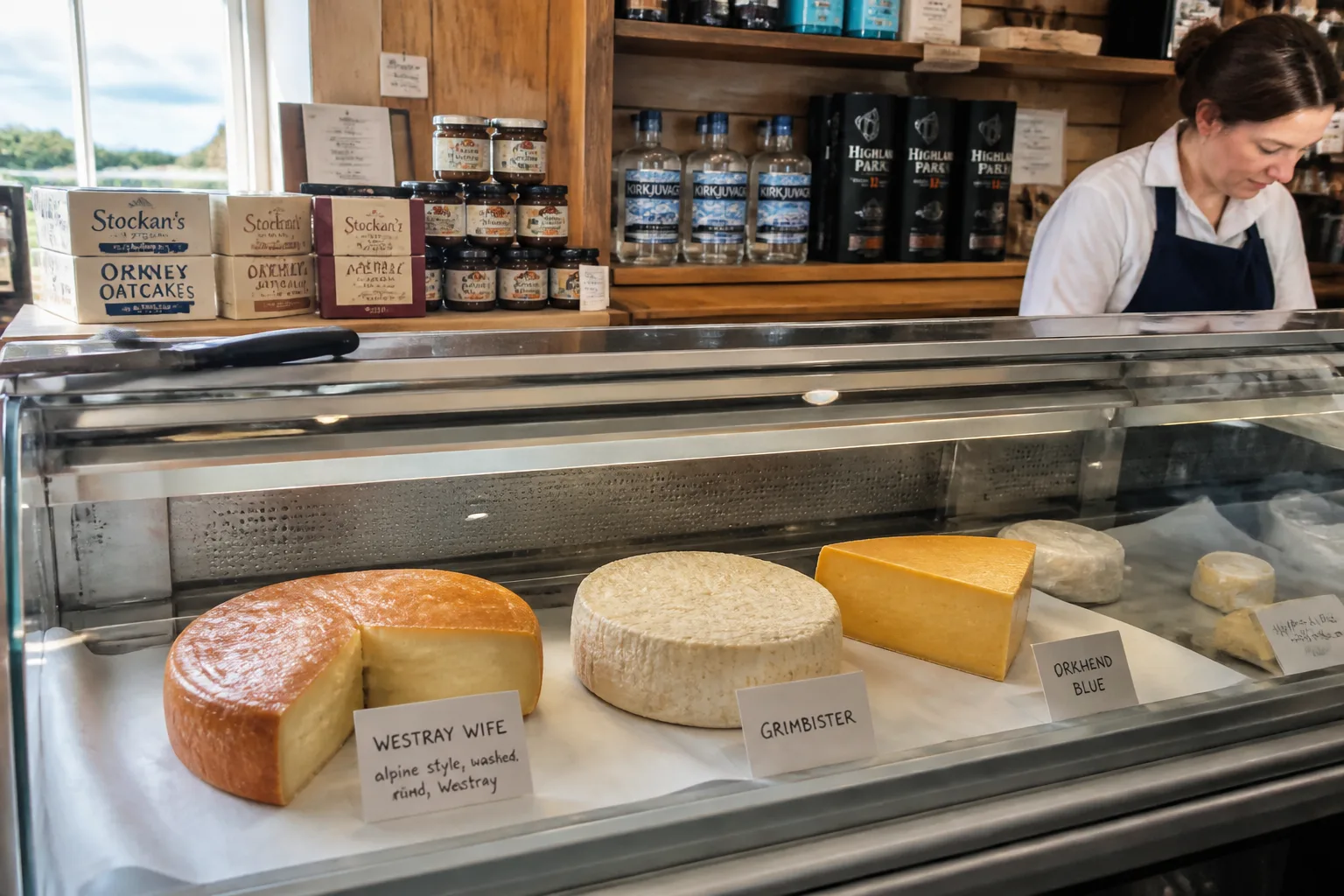
The third strand of the Orkney cheese story sits across the Westray ferry, on the family farm of Jason and Nina Wilson — Wilsons of Westray, the producers of the celebrated Westray Wife. Made from the farm’s own milk, Westray Wife is the only alpine-style washed-rind cheese ever made on Orkney: the rind washed through maturation, ready at about two months old, with the dense, complex, faintly meaty character of a Reblochon or young Beaufort. It took Gold at the Royal Highland Show in 2017 and is named after the famous Neolithic figurine discovered in 2009 at the Links of Noltland — the earliest representation of a human face ever found in the UK.
Recent news: in spring 2024 the Wilsons stepped back from cheesemaking, sold off some of their equipment, and have been mentoring Barry Graham at Burnside Cheese in Rendall (KW17 2NZ). Barry — who learned his craft from his Westray grandmother — has brought two of the three former Wilsons cheeses back into production: Noltland Castle (rebranded as Norseman) and the spherical Cannonball. The Westray Wife itself sits on pause; Burnside continues with its own four-flavour farmhouse range (Original, Pepper and Chive, Chilli, Smoked) alongside the revived recipes. Ask at any Kirkwall or Stromness deli for the current state of play — it changes by the month.
Tasting Notes and How to Read Each Cheese
A short crib sheet for what you're actually tasting when you sit down with a board of four:
Where to Buy Orkney Cheese
Specialist delis
Jollys of Orkney (Hatston Industrial Estate, Scott's Road, Kirkwall) is the easiest one-stop — Grimbister in three sizes, Orkney cheddar by the block, and a rotating slate of small producers. Kirkness & Gorie on Broad Street (trading in Kirkwall since 1859) is the cheese-cabinet specialist with 60-plus cheeses on the counter at any time. Bayleaf Delicatessen on Victoria Street in Stromness covers the west side of the Mainland — the friendliest counter for asking what's freshest this week.
Butchers and farm shops
E. Flett Quality Butcher in Stromness sells Grimbister fresh and unpackaged, sliced to order from the wheel. The wider farm-shop circuit (Brig Larder in Kirkwall, smaller West Mainland producers) carries the cheeses too — see our Orkney farm shop guide for full opening hours and locations.
The Farmers' Market
The single best food morning of the month is the Orkney Farmers' Market at the Masonic Hall on Castle Street in Kirkwall — last Saturday of every month. Check the current opening hours before you go — they have moved before. Most small producers (and occasionally Burnside) bring fresh stock here.
Direct from the farm
Grimbister Farm in Firth, near Finstown (KW15 1TT) handles direct sales by phone arrangement only — call ahead, don't turn up unannounced. Burnside Cheese at Rendall (KW17 2NZ) is wholesale-focused; their cheese is easiest to find through the delis above. Wilsons of Westray have paused production — the revived recipes (Norseman and Cannonball) now travel via Burnside.
Pairing Orkney Cheese: Bannocks, Whisky, Honey
The local Orkney pairing tradition is short and assured. With Grimbister: a warm bere bannock, a spoonful of Orkney heather honey, and an oatcake on the side. With Orkney Extra Mature Cheddar: a glass of Highland Park 12, dark fruit chutney, and a dense brown malt loaf. With Westray Wife (when in production): a glass of Scapa single malt, a few walnuts, and crisp apple slices to cut through the rind. A small jug of cream and a black pepper grinder go on the table whatever else is happening.
Frequently Asked Questions
What makes Grimbister cheese different?
Grimbister is a fresh, young, lactic cheese — soft, crumbly, almost paneer-textured — made by Anne Seator at Grimbister Farm in Firth, near Finstown. It's "probably the earliest style of cheese made in Orkney," a lightly pressed farmhouse style that predates the islands' industrial cheddar by generations. It tastes delicate and mild when fresh, then develops a lemony tang after three or four days. Unlike Orkney's better-known cheddars, it isn't aged and isn't pressed hard.
Where is the best place to buy Orkney cheese?
For Grimbister, Jollys of Orkney in Kirkwall and E. Flett Quality Butcher in Stromness are the easiest sources; Kirkness & Gorie in Kirkwall carries the widest range alongside 60-plus other cheeses. For Orkney Extra Mature Cheddar, the Orkney Cheese Company's own block is on every deli counter and most supermarkets. For Burnside cheeses, ask at any Kirkwall or Stromness deli. The Orkney Farmers' Market on the last Saturday of every month at the Masonic Hall in Kirkwall is also worth timing your trip around.
Can you visit the Orkney cheese farms or dairies?
Not in the way you can visit a whisky distillery. Grimbister Farm in Firth is a working dairy farm — direct sales by phone arrangement only, no visitor centre. The Orkney Cheese Company on Crowness Road in Kirkwall is a working creamery without public tours, though the cheese is widely sold across the islands. Burnside Cheese at Rendall is small-scale and wholesale-focused. The closest you'll get to a producer is the Farmers' Market or a chat with the cheese-counter staff at one of the Kirkwall delis.
Is Orkney cheddar vegetarian?
The standard Orkney Cheese Company cheddars are vegetarian — the creamery uses a vegetable rennet to create the curds. Westray Wife is vegetarian (made with vegetarian rennet); Grimbister and Burnside cheeses are best checked directly with the producer or deli, as recipes vary. For dependable vegetarian Orkney options, ask at Kirkness & Gorie or Bayleaf Delicatessen, both of which carry several vegetarian-rennet cheeses on the same counter.
Are Wilsons of Westray still making cheese?
No — Jason and Nina Wilson stepped back from cheesemaking in spring 2024. Two of their three signature cheeses have since been revived by Barry Graham at Burnside Cheese in Rendall: Noltland Castle (now branded Norseman) and the spherical Cannonball. The original Westray Wife alpine washed-rind is currently paused. Ask at any Kirkwall deli for the current state of the revival — it changes from one season to the next.
Sources & further reading
The facts in this guide were checked against the following authoritative sources.
- Orkney.com — Exploring Orkney's larder: cheese — Washed-rind method; producer overview
- The Orcadian — new farmers market opening time — Farmers market hours update
- Wilsons of Westray — official producer site — Production paused 2024
- Cheese.com — Westray Wife profile — Washed-rind classification