Quick Navigation
- Primula Scotica — A Flower from One Place on Earth
- Where to find it
- Spring Squill, Thrift and the Coastal Carpet
- Orchids, Iris and the Damp Machair
- Hoy, Rousay and the Late-Summer Moorland
- Orkney's Four Wildflower Habitats at a Glance
- Walking the Wildflower Trail — and Looking After It
- Frequently Asked Questions
- Where is the best place to see the Scottish Primrose (Primula scotica) in Orkney?
- When does Primula scotica flower?
- Where does Scottish Primrose grow in the world?
- When is the best time to see wildflowers in Orkney?
- How tall is the Scottish Primrose?
- Is the Scottish Primrose endangered?
- Can I pick wildflowers in Orkney?
- Sources & further reading
Orkney has a wildflower it shares with one other place on Earth. The Scottish Primrose — Primula scotica — grows nowhere outside northern Scotland: only here, across the Pentland Firth in Caithness, and along a thin strip of the Sutherland coast. The whole world's population fits inside a few hundred clifftop turf patches. Add carpets of bright blue Spring Squill in May, pink cushions of Thrift on every cliff edge through June, marsh orchids in damp meadows, and bog asphodel on the Hoy moors in late July, and you have one of the most distinctive floral calendars in the British Isles.
Primula Scotica — A Flower from One Place on Earth
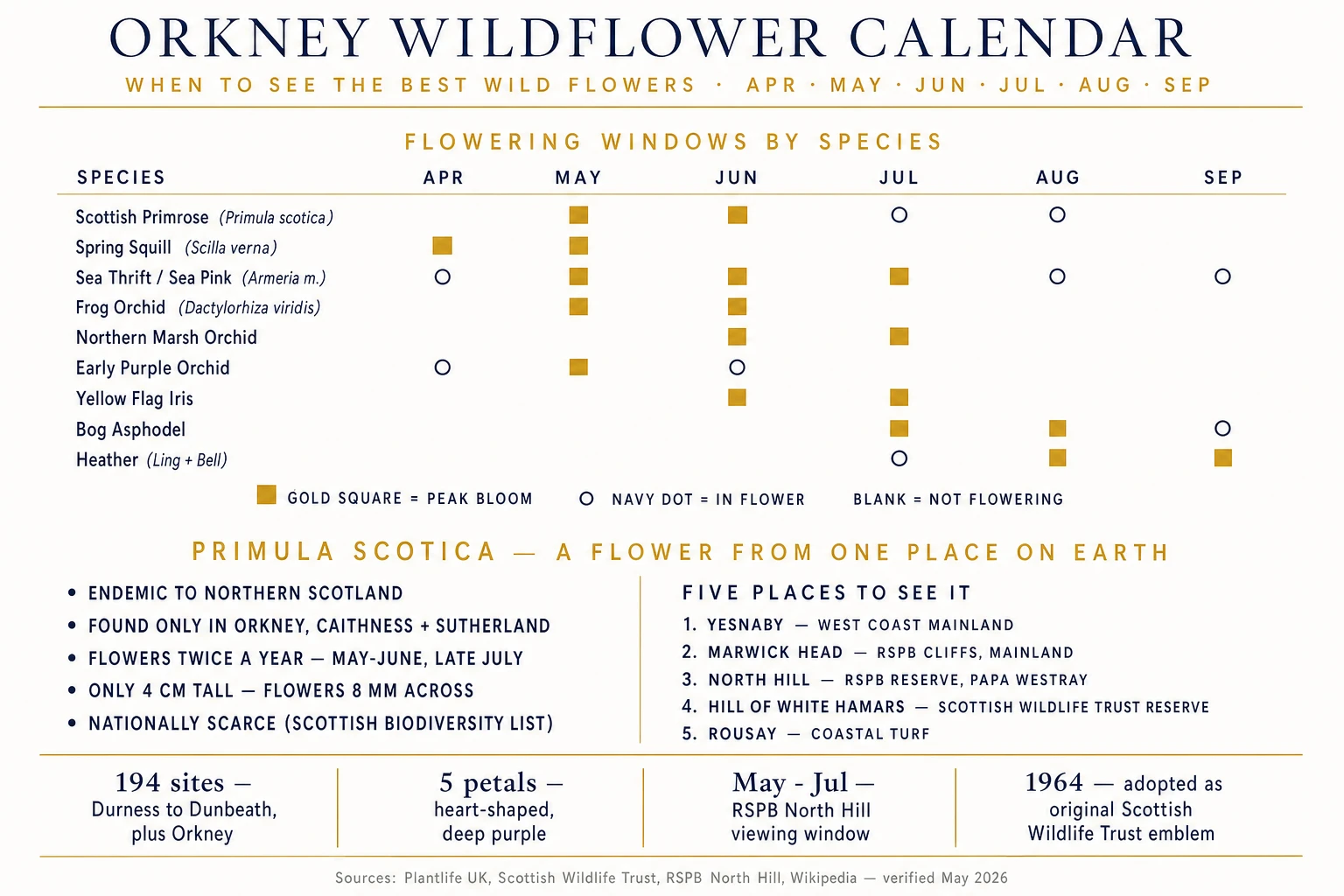
Of all Orkney's wildflowers, only one is genuinely a global rarity. The Scottish Primrose — Primula scotica — is endemic to northern Scotland: Plantlife and the Scottish Wildlife Trust both confirm it grows nowhere else in the world. It is the county flower of Caithness and was the original emblem of the Scottish Wildlife Trust when the charity was founded in 1964. Its global home is one strip of Sutherland and Caithness coastline plus the Orkney Islands — full stop.
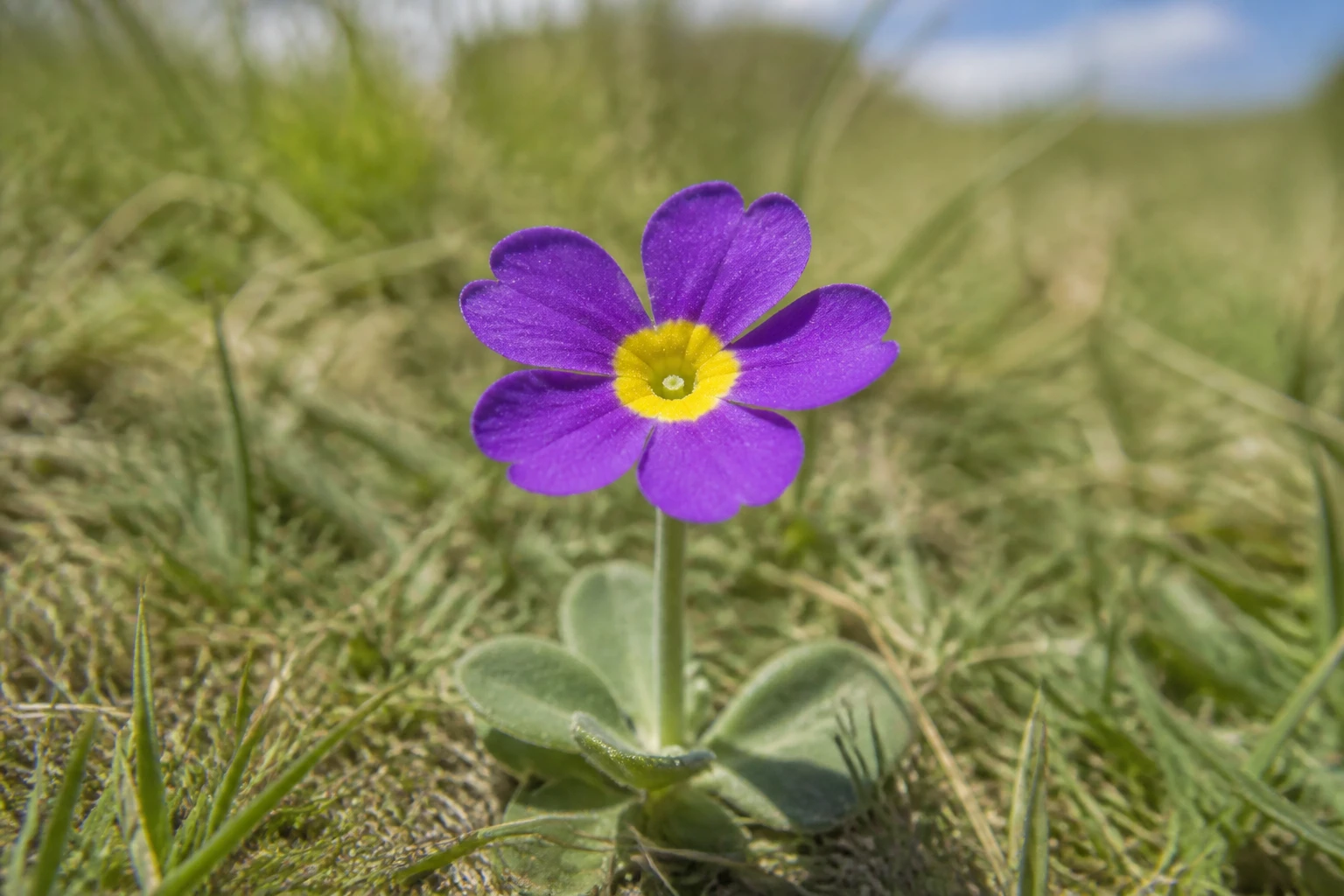
The plant is genuinely tiny: a rosette of mealy grey-green leaves at ground level and a slender stem barely 4 cm tall, with a cluster of dark purple flowers no bigger than a fingernail at the top. Each bloom has five heart-shaped petals and a bright yellow eye in the centre — Primula scotica at a glance looks like a miniature, jewel-bright cousin of the familiar primrose. It is classed as nationally scarce on the Scottish Biodiversity List, with a 2008 survey identifying 194 sites on the Caithness-Sutherland mainland between Durness and Dunbeath, plus the separate Orkney populations.
Its other peculiarity is the flowering pattern. Primula scotica blooms twice in a single summer: a first flush from mid-May into early June, then a second wave in late July and August once the first set has gone to seed. RSPB North Hill on Papa Westray, one of the easiest places to see it, advises visiting between May and July — that window catches the back end of the first flush and the start of the second. For a fuller seabird-and-flora day on the same headland, our companion guide to Orkney's birdwatching hotspots walks through North Hill, Marwick Head and Noup Head in turn.
Where to find it
You need short, well-grazed coastal turf, very close to the cliff edge, on lime-rich soils above Old Red Sandstone. Five reliable spots:
- Yesnaby — west coast Mainland. Park at the Yesnaby car park, walk south towards the Castle sea stack, scan the short turf within five metres of the cliff edge.
- Marwick Head (RSPB) — clifftop turf below the Kitchener Memorial, on the seaward side of the path.
- North Hill (RSPB), Papa Westray — described by RSPB as "perhaps Orkney's finest area of maritime heath". Visit May-July; keep to the marked trail.
- Hill of White Hamars — a Scottish Wildlife Trust reserve on South Walls.
- Rousay — west coast clifftops above Saviskaill Bay.
Spring Squill, Thrift and the Coastal Carpet
If Primula scotica is the connoisseur's flower, the showstoppers are the species that paint the cliffs in colour. Spring Squill (Scilla verna) opens first — in April and May, hundreds of six-pointed sky-blue stars on slender stems form true carpets across the short turf at Yesnaby, the Brough of Birsay, and Dingieshowe in Deerness. Each plant is only 5-15 cm tall, but when they flower in numbers the effect is a haze of pale blue on bright green.
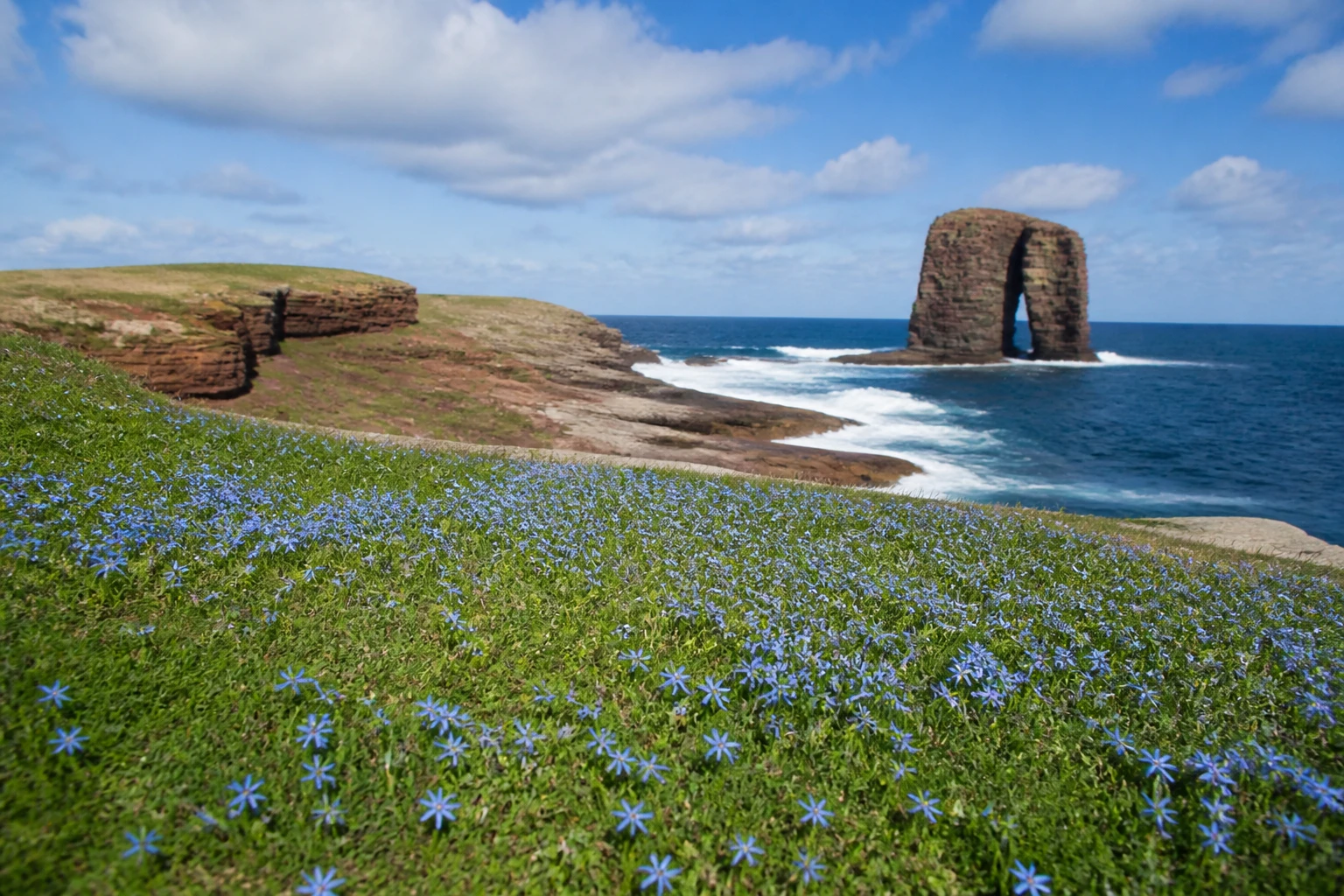
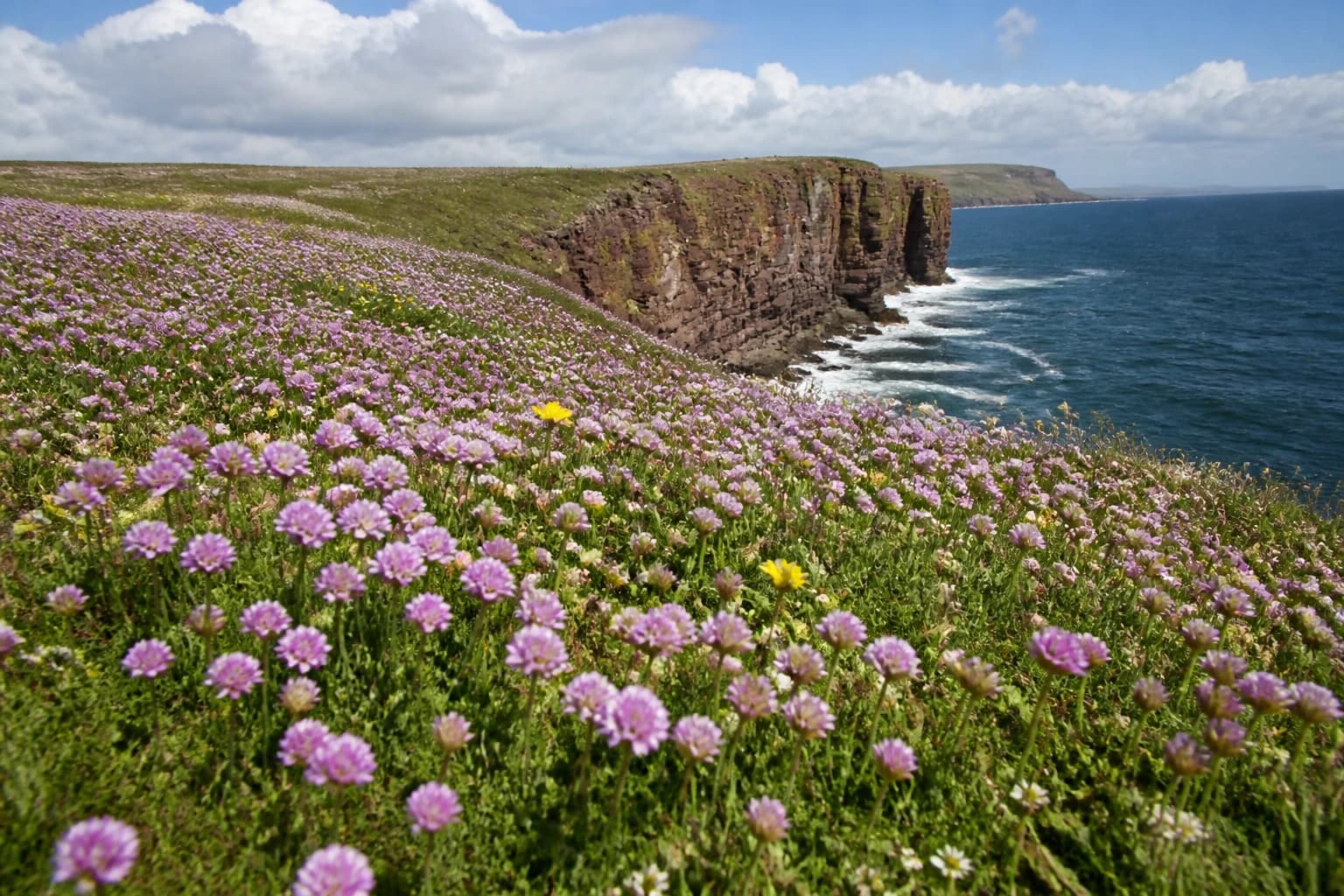
Right behind the squill, Thrift (Armeria maritima, also known as Sea Pink) takes over. Its spongy green cushions push up slender stems topped with bright pink pom-pom flowerheads, and the whole plant is built to take wind and salt-spray. Thrift flowers April to October, but peaks in June and early July, when long stretches of the Orkney cliff edge turn properly pink. You can stand on the headland at Marwick Head or Yesnaby in late June and look down a cliff face stitched with thrift cushions, kittiwakes wheeling below.
Thrift is the easiest wildflower in Orkney to identify and the most photographed: a perfect pink globe on a wiry stem, usually growing in tussocks 10-20 cm tall. It tolerates extreme exposure — the same plant grows on the very lip of a 300-metre cliff at St John's Head on Hoy.
Planning your trip
Staying overnight? Compare live prices and availability across Orkney on Booking.com.
Compare Orkney staysWe earn a small commission if you book through this link, at no extra cost to you.
Orchids, Iris and the Damp Machair
Orkney supports several wild orchids, all worth bending down for. The most visible is the Northern Marsh Orchid (Dactylorhiza purpurella) — upright spikes of dense, bright reddish-purple flowers, 10-30 florets per spike, 20-30 cm tall, easy to spot above the surrounding grass in damp meadows, ditch margins and roadside verges through June and July.
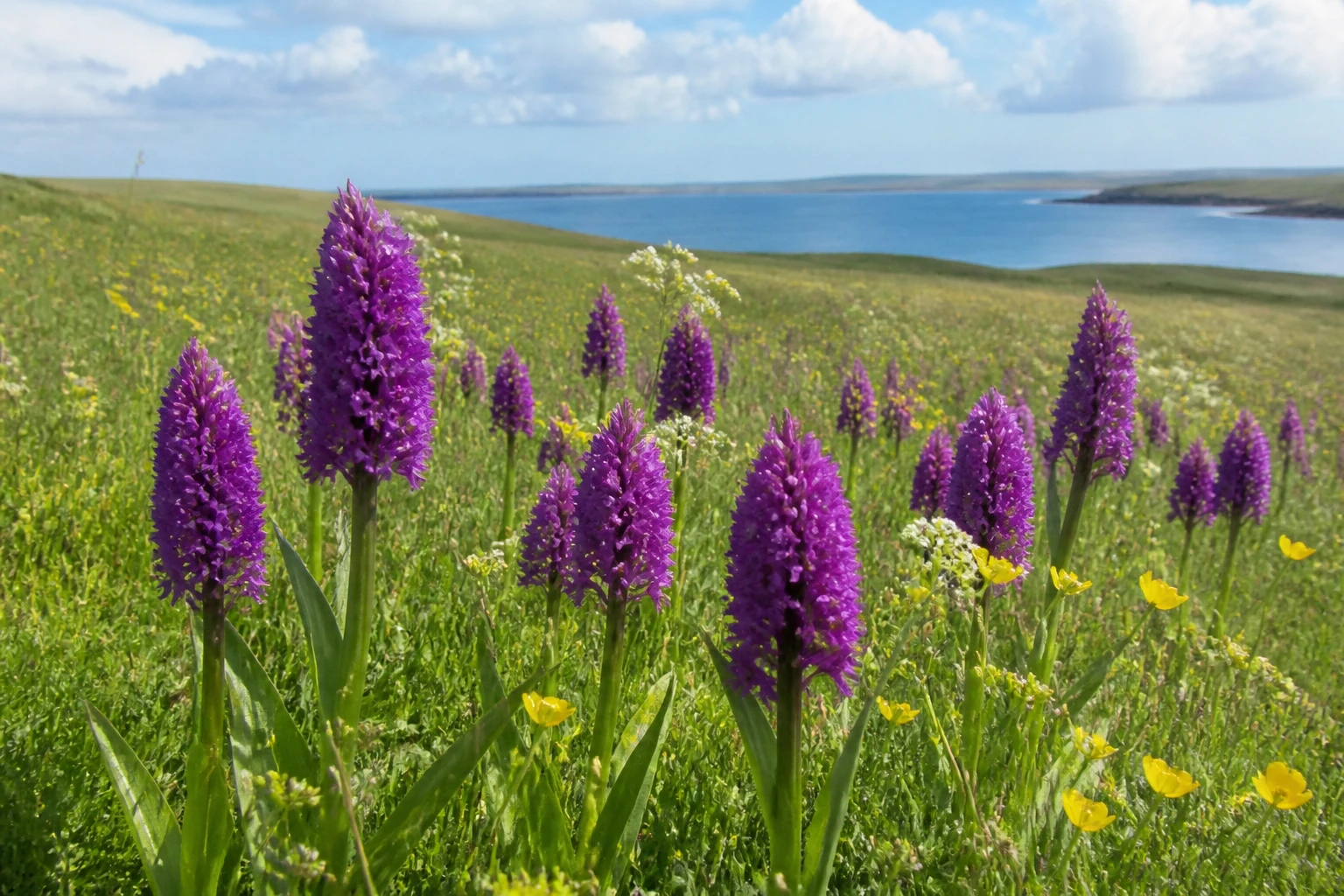
The Early Purple Orchid (Orchis mascula) opens earlier — from late April into May — on coastal grasslands and the species-rich machair grasslands of Sanday. The Frog Orchid (Dactylorhiza viridis) is the trickiest to find: small, green and inconspicuous, only 10-25 cm tall, with greenish flowers often tinged with reddish-brown that look (with imagination) like miniature frogs. It flowers in late May and early June, in older un-fertilised grasslands — Mull Head reserve in Deerness is a known spot.
In the damper places, Yellow Flag Iris opens its bright lemon-yellow flowers in June and July at loch margins and along ditches; Meadowsweet follows with creamy-white fragrant flowerheads in July; and damp roadside verges shimmer with white and purple-streaked Eyebright.
Hoy, Rousay and the Late-Summer Moorland
From late July, the wildflower story moves uphill. Hoy and Rousay, with their hills and acidic peat soils, become carpets of Heather — both Ling (Calluna vulgaris) with its tiny pale-pink bells, and Bell Heather (Erica cinerea) with deeper magenta-pink urns. The moor turns purple from late July through August. Walking the path to the Old Man of Hoy across Moor Fea, you cross half a mile of pure heather in full bloom.
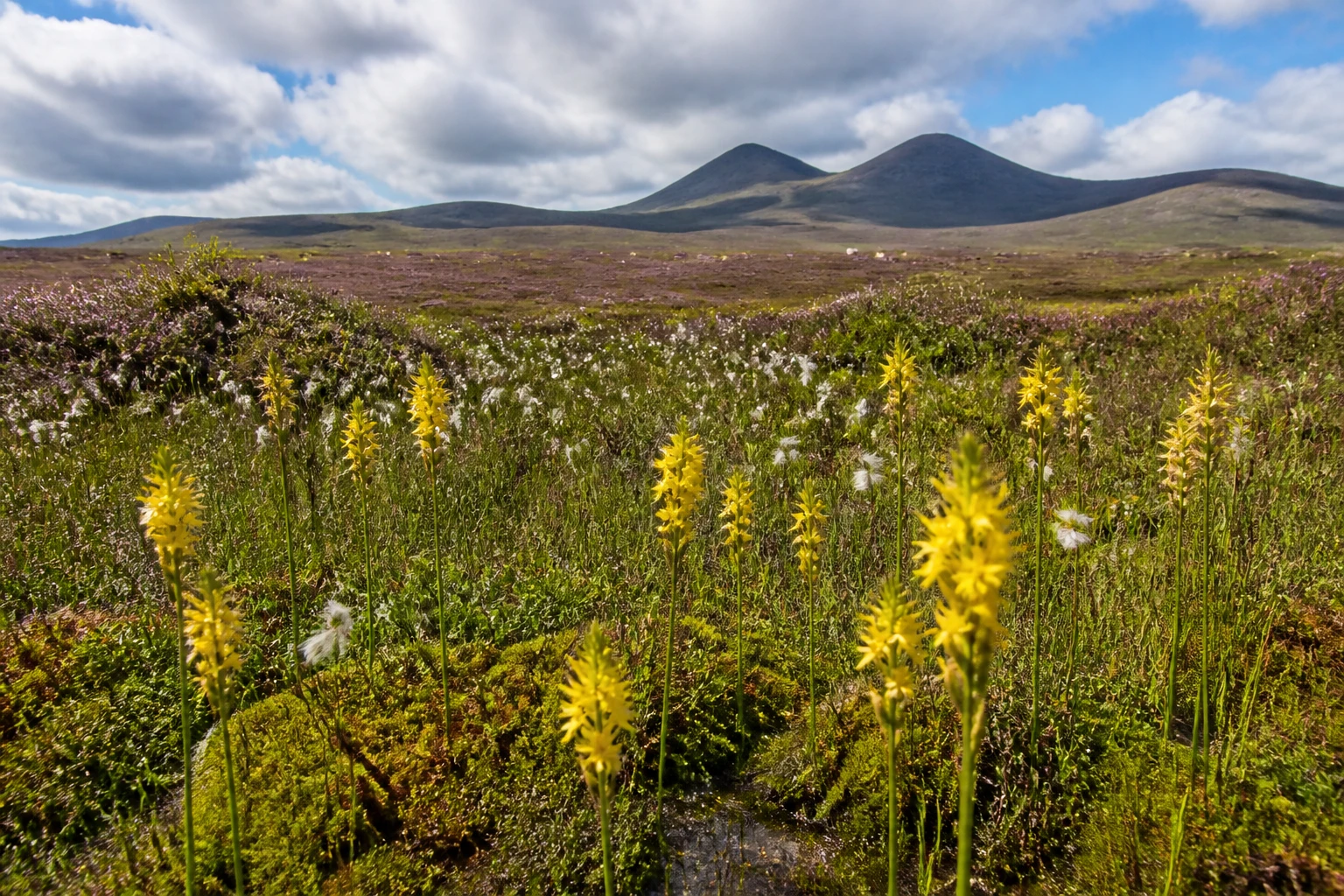
Through the same weeks, Bog Asphodel (Narthecium ossifragum) opens its bright lemon-yellow star-shaped flowers, each about 18 mm across, on 30 cm spikes through the wet peat. Cotton grass tussocks add white seed-heads; round-leaved sundews glint red where the ground is wettest. By September the asphodel turns coppery-orange, the heather darkens, and the moor takes on the bronze tones that hold through autumn. For the wider context of when to come for this kind of landscape, our first-timer's guide on the best time to visit Orkney sets the calendar for everything from puffins to peak heather.
Orkney's Four Wildflower Habitats at a Glance
Walking the Wildflower Trail — and Looking After It
Orkney's headline flowers are all easy to reach on foot. The best three-day wildflower itinerary in late May or June would be one day at Yesnaby (squill + thrift + Primula scotica), one day at Marwick Head with the cliff colony (thrift + cliff-edge Primula + companion seabirds), and one day on Hoy walking towards the Old Man (heather coming in, bog asphodel underfoot). Add a Papa Westray day-trip in early July and you cover the whole calendar.
Many of the key sites are Sites of Special Scientific Interest or active RSPB reserves; Plantlife Scotland and the Scottish Wildlife Trust manage others. Practical rules of the cliff:
- Stick to the marked paths. Maritime heath turf bruises easily and Primula scotica grows literally underfoot — one careless step can crush a season's flowering.
- Never pick wildflowers. Several Orkney species are protected; all of them are short-flowering and need every bloom for seed. Take photos, leave roots.
- Keep dogs on leads near cliff colonies. Ground-nesting birds share these habitats in May-July.
- Report sightings to the Orkney Biological Records Centre — especially Primula scotica counts, which feed national monitoring.
- Pack waterproofs and boots even in June. Orkney clifftops are exposed; the wind that keeps the turf short also drives squalls. Bog Asphodel terrain is genuinely wet.
Orkney's flora is part of the same fragile coastal system as the seabird colonies and the seal haul-outs — for the wider wildlife picture, our companion piece on Orkney's marine life covers what's in the water below the same cliffs.
Frequently Asked Questions
Where is the best place to see the Scottish Primrose (Primula scotica) in Orkney?
The most reliable spots are short coastal turf within five metres of the cliff edge at Yesnaby and Marwick Head on the Mainland, and North Hill RSPB reserve on Papa Westray. Hill of White Hamars on South Walls (a Scottish Wildlife Trust reserve) and the west coast of Rousay are quieter alternatives. Take it slowly — the plant is only 4 cm tall and very easy to miss.
When does Primula scotica flower?
Unusually, it flowers twice a year. The first flush opens in May and June, and a second wave appears in late July and August after the first has gone to seed. RSPB advises visiting between May and July for the most reliable viewing. Both flowerings overlap with the peak Orkney seabird season.
Where does Scottish Primrose grow in the world?
It is endemic to northern Scotland and found nowhere else on Earth. Its world range is a thin strip of the Caithness and Sutherland coast (194 sites recorded between Durness and Dunbeath in a 2008 survey) plus the Orkney Islands. It does not grow anywhere south of the Highlands, nowhere in Shetland, and nowhere outside Scotland.
When is the best time to see wildflowers in Orkney?
Late May to mid-July is the peak. That window catches Spring Squill (April-May), the first flowering of Primula scotica (May-June), Thrift in full bloom (June), Northern Marsh Orchid (June-July), and the early Frog Orchids (late May-early June). For heather and bog asphodel, come in late July and August.
How tall is the Scottish Primrose?
About 4 centimetres tall when in full flower. The deep purple flowers are only 8 mm across, with five heart-shaped petals around a bright yellow eye. The plant is so small that most visitors walk straight past their first one; once you have your eye in, you start seeing them in patches across the short turf.
Is the Scottish Primrose endangered?
It is classed as "nationally scarce" on the Scottish Biodiversity List, but not endangered — populations are stable on managed sites where grazing keeps the turf short. The main threats are habitat scrub-over (if grazing stops), trampling at popular viewpoints, and climate change drying out the coastal turf it depends on. Conservation work by Plantlife, the Scottish Wildlife Trust and RSPB is what keeps the populations healthy.
Can I pick wildflowers in Orkney?
No. Many Orkney species — including Primula scotica, the orchids, and Bog Asphodel — are either legally protected or vulnerable to over-picking. Several of the key viewing sites are within SSSIs or RSPB reserves where picking is forbidden. Take photographs, leave the flowers in place for the next walker and for seed-set.
Base yourself somewhere central — Stromness or Kirkwall — in late May or June, leave the car for the cliff-path days, and Orkney's wildflower calendar will deliver one of the most distinctive botanical experiences in Britain. Our full list of Orkney hotels, B&Bs and holiday homes is a good place to start working out that base. The Scottish Primrose alone is worth the trip.
Sources & further reading
The facts in this guide were checked against the following authoritative sources.
- Scottish Wildlife Trust — Hill of White Hamars reserve — South Walls location confirmed
- BSBI — Dactylorhiza viridis species account — frog orchid flowering data
- Scottish primrose — NatureScot — two flowering periods and Scottish endemic status
- RSPB — Marwick Head reserve, Orkney — Orkney coastal wildflowers