Quick Navigation
- Hiring Locally vs Bringing Your Own Campervan
- Campervan and Motorhome Hire Companies Based in Orkney
- Ferry Routes for Motorhomes and Campervans
- Campsites and Motorhome Stops Across Orkney
- Driving in Orkney with a Campervan
- What Does a Campervan Trip to Orkney Cost?
- Frequently Asked Questions About Campervans in Orkney
- Can you take a motorhome on the ferry to Orkney?
- Do I need a special licence to drive a hire campervan in Orkney?
- Is wild camping allowed in Orkney?
- What is the minimum age to hire a campervan in Orkney?
- Are pets allowed on the ferry to Orkney?
- When is the best time to take a campervan to Orkney?
Campervan hire in Orkney is one of the most rewarding ways to explore an archipelago where the distances are short, the roads are quiet, and the landscape shifts from standing stones to sea cliffs in a single afternoon. Having a base that moves with you suits these islands precisely. This guide covers the local hire companies based on Orkney itself, the ferry routes for those bringing their own vehicle from mainland Scotland, the campsite network from Kirkwall to the outer islands, and what a week on the road here realistically costs.
Hiring Locally vs Bringing Your Own Campervan
There are two ways to arrive in Orkney with a campervan. The first is to hire one directly on the islands from a local operator, which means no ferry vehicle surcharge, no long drive north through Scotland, and the practical advantage of local knowledge from the person handing over the keys. The second is to hire from a mainland Scotland company and bring the vehicle across on one of the ferry services from Caithness or Aberdeen. Both approaches work well; the choice depends mostly on where you are travelling from and how long you have available.
Visitors travelling from the south may find it convenient to collect a mainland hire vehicle and bring it across on the overnight sailing from Aberdeen. Those who prefer to travel light and deal with everything on arrival will find the local hire option straightforwardly practical. Those flying to Kirkwall direct and wanting a campervan waiting for them will have little choice but to hire locally, and the local operators are well set up for exactly this.
On the prices below: these are indicative, not live. Rates move with season, operator and availability, and the cheapest option on any given date is often not the one listed here. Check the current rate before you book.
Campervan and Motorhome Hire Companies Based in Orkney
Two companies currently offer campervan and motorhome hire based on the islands.
Northern Lights Motorhome Hire runs a single vehicle — a 2023 Ford motorhome with a four-berth layout. Rates are £140 per night or £800 per week in low season (November to March), £150 per night or £900 per week in mid-season (April and October), and £170 per night or £1,050 per week at peak season (May to September).
Stay in Stromness offers a VW campervan for hire from £130 per night with a minimum of three nights. The Stromness base puts you immediately beside the harbour and within easy reach of the Neolithic sites on the West Mainland.
Peer-to-peer platforms such as Camplify list privately owned campervans from Orkney owners at variable rates, which can be competitive outside the summer peak.
Planning your trip
Staying overnight? Compare live prices and availability across Orkney on Booking.com.
Compare Orkney staysWe earn a small commission if you book through this link, at no extra cost to you.
Ferry Routes for Motorhomes and Campervans
Two operators cross to Orkney from mainland Scotland and both welcome motorhomes and campervans. The full details of all routes are in the complete guide to getting to Orkney by ferry, flight and road, but the essentials for vehicle travellers are below.
NorthLink Ferries operates from two Scottish mainland ports. The most popular route for campervan travellers is Scrabster to Stromness: a 90-minute crossing with up to two sailings per day on most days. It is the shortest sea crossing to the Mainland and sets you down in Stromness, well positioned for the western sites. NorthLink also runs an overnight sailing from Aberdeen to Kirkwall that departs Aberdeen in the early evening and arrives at Hatston pier around 11 pm; cabins are available and the route suits those travelling from further south.
Pentland Ferries runs from Gills Bay in Caithness to St Margaret’s Hope on South Ronaldsay, a 1 hour 10 minute crossing. Up to three sailings run daily and it is a fast option for those travelling up the A9. Vehicle and passenger fares are charged separately on all three routes.
| Route | Crossing time | Vehicle fare (single, 2026) | Adult passenger (single) | Operator |
|---|---|---|---|---|
| Scrabster → Stromness | 90 minutes | £72–£79 (motorhome <6m) | £22.10–£26.00 | NorthLink Ferries |
| Aberdeen → Kirkwall | ~6 hours (overnight) | £108–£149 (motorhome <6m) | £27.50–£42.00 | NorthLink Ferries |
| Gills Bay → St Margaret’s Hope | 1h 10min | £55 (<5m) / £77 (5–6m) / £114 (6–8m) | £23 | Pentland Ferries |
A few practical points: passengers cannot remain in their vehicles during the crossing and must move to the passenger decks. Gas canisters must remain sealed throughout the voyage. Vehicle spaces fill up quickly in June, July and August, and early booking is strongly advised, particularly on the Scrabster route where deck space is limited.
Campsites and Motorhome Stops Across Orkney
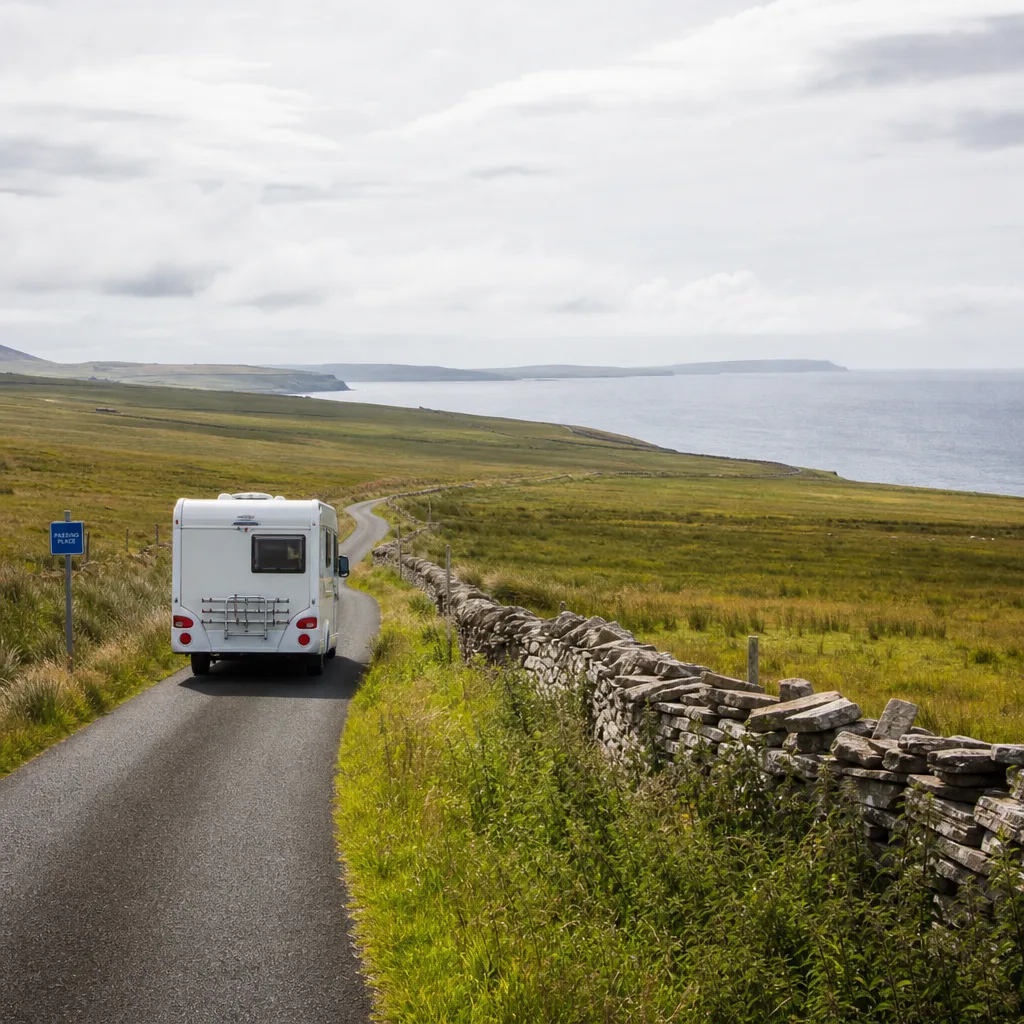
Orkney has a compact but well-spread campsite network. Wild camping is permitted on unenclosed land under the Land Reform (Scotland) Act 2003, but the Orkney Islands Council and national motorhome bodies both discourage overnight parking in lay-bys and field verges. In Orkney this matters in practice: lay-bys on single-track roads are passing places, not overflow parking, and blocking them creates real difficulties for local traffic and emergency vehicles.
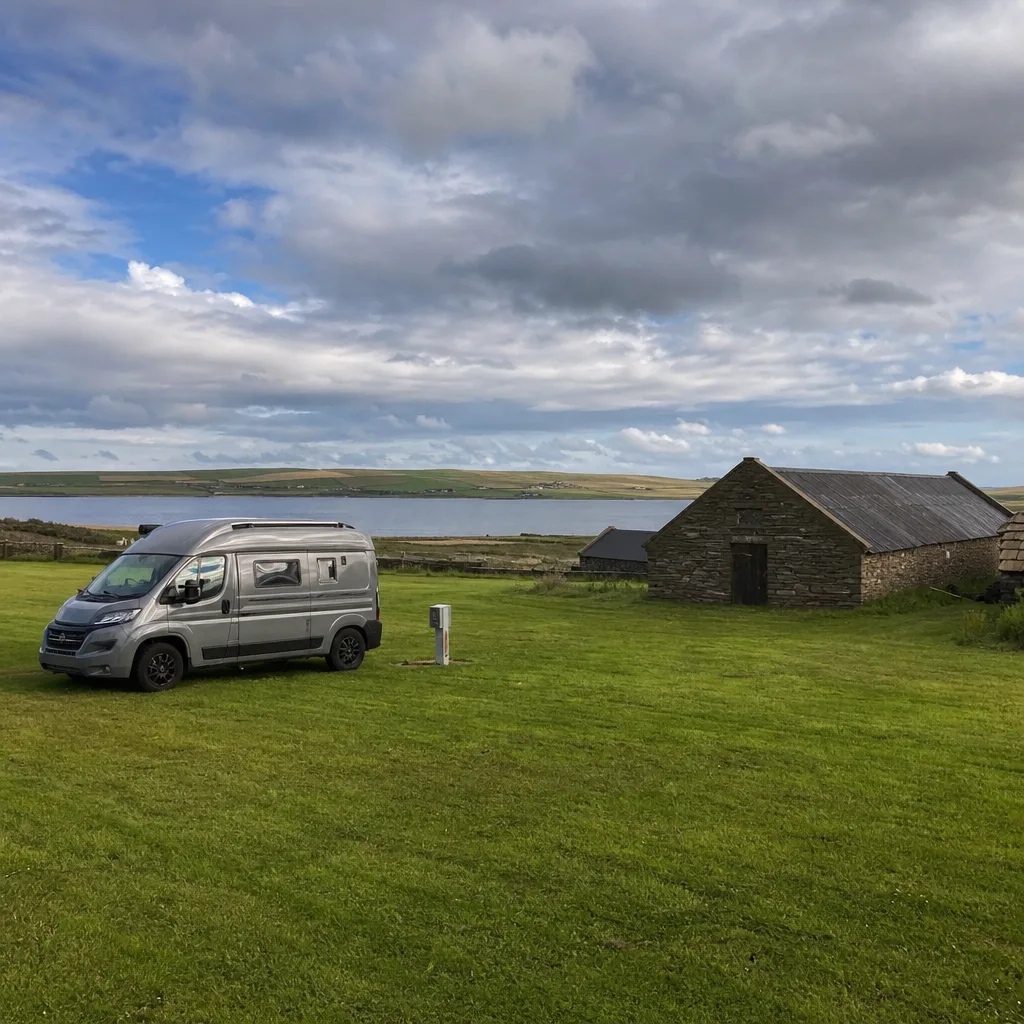
The two main Kirkwall sites are Kirkwall Bay Touring Park, about 1.5 miles north of the town on the bay shore, and Pickaquoy Caravan and Camping, a central Kirkwall site with 80 pitches. Kirkwall Bay has 27 hardstanding pitches, all with electric hookup, plus heated showers, grey waste and chemical waste disposal — it takes campervans, motorhomes and caravans only, and no tents are permitted. Pickaquoy has a mix of hardstanding and grass pitches, 30 of them with electric hook-ups.
In Stromness, Point of Ness Campsite has hard-standing and grass pitches with bay views at the south end of town, with electric hookup available. Birsay Hostel and Campsite in the northwest has 28 pitches including 13 with electric hookup, and sits close to the Brough of Birsay and Broch of Gurness. On the East Mainland, Deerness Community Centre offers four hardstanding motorhome pitches with electric hookup and shower facilities.
For those heading to the outer islands, 59 Degrees North on Sanday provides five hardstanding motorhome pitches with electric hookup, grey and black waste disposal, and a fresh water point, making it the best-equipped site beyond the Mainland.
Several Caravan and Motorhome Club Certified Locations operate across the West Mainland and South Ronaldsay for club members. Chemical and grey waste disposal is confirmed at Kirkwall Bay Touring Park and Birsay Outdoor Centre.
Driving in Orkney with a Campervan
Orkney’s road network is more forgiving than its island setting might suggest. The main A-roads between Kirkwall, Stromness and St Margaret’s Hope are standard two-lane carriageways. The minor roads to individual properties, cliff tops and outer-island ferry terminals are often single-track with passing places. For a thorough read before you go, the guide to driving in Orkney covers single-track etiquette, parking rules and what to expect across the different parts of the Mainland.
The key rule for campervan drivers is to treat passing places correctly: pull in to let oncoming traffic pass, and do not park overnight in them. Satellite navigation should be used with caution; GPS systems regularly route larger vehicles through the narrow back lanes of Kirkwall and Stromness town centres, which are not appropriate for motorhomes. Carry a paper map or offline route and bypass historic town centres.
Fuel stations are concentrated in Kirkwall and Stromness; fill up when you can before heading north or west. Most vehicles under three metres in height circulate without difficulty. Wind can affect larger vehicles on exposed roads such as the A965 between Finstown and Stromness in westerly conditions.
- Use passing places to let oncoming vehicles through and to allow faster traffic to overtake.
- Never park overnight in a lay-by or passing place: it blocks the road.
- Avoid Kirkwall and Stromness town centres with sat-nav; use a map and ring-road approach.
- Fill up with fuel in Kirkwall before heading to the northwest or the outer islands.
- Gas canisters must remain sealed during ferry crossings.
What Does a Campervan Trip to Orkney Cost?
The figures below are a planning guide based on 2026 ferry tariffs. Campsite pitch fees typically run £26–£33 per night at the main sites, with electric hookup at the upper end. Fuel for a full week on the Mainland usually requires one or two fill-ups; diesel at local stations runs to broadly current mainland Scotland prices.
On the Scrabster to Stromness route, a return crossing for a motorhome under six metres and one adult passenger costs approximately £210 at peak season (vehicle £79 each way, adult passenger £26 each way). In low season the same return comes in under £190. Add campsite fees of £75–£125 for five nights, fuel for a week on the Mainland, and entrance fees for paid attractions such as Skara Brae (£14 online, £16 walk-up) and Highland Park Distillery (£30 for the Welcome Experience tour), and a five-night trip for two people using your own campervan typically runs between £380 and £550, exclusive of food.
Local hire adds the vehicle cost on top of those running costs but removes the ferry vehicle charge entirely. For visitors flying into Kirkwall rather than driving, local hire is the more practical and usually more economical option. Those arriving by the Aberdeen overnight sailing will pay more for the crossing but save the long drive north through the Highlands.
For groups who prefer a mix of freedom and a fixed base, there is a wide range of self-catering accommodation across Orkney alongside the campsite options, from harbourfront apartments to farmhouses with coastal views.
Vehicle fares are charged by motorhome length and by season, so a single “from” price is misleading — see the fare table above, and confirm with the operator before booking. Crossing times and frequencies checked against NorthLink and Pentland Ferries’ published 2026 timetables on 20 September 2026.
Frequently Asked Questions About Campervans in Orkney
Can you take a motorhome on the ferry to Orkney?
Yes. Both NorthLink Ferries (Scrabster to Stromness, and Aberdeen to Kirkwall) and Pentland Ferries (Gills Bay to St Margaret’s Hope) accept motorhomes and campervans. Vehicle berths are limited and should be booked well in advance, particularly in summer. Passengers must vacate the vehicle deck once the ferry is under way.
Do I need a special licence to drive a hire campervan in Orkney?
A standard UK driving licence covers most campervans and motorhomes up to 3.5 tonnes. No additional endorsement is required for the typical hire vehicles offered by Orkney operators. Check with your hire company if your chosen vehicle exceeds that weight.
Is wild camping allowed in Orkney?
Wild camping on unenclosed land is permitted under the Land Reform (Scotland) Act 2003. However, lay-bys on Orkney’s single-track roads are passing places and must not be used as overnight stops. Using official campsites also gives you access to electric hookup, water, and waste disposal that roadside camping cannot.
What is the minimum age to hire a campervan in Orkney?
Minimum hire ages vary sharply between the two Orkney-based operators: Northern Lights requires drivers to be 30 to 79, while Stay in Stromness hires to drivers aged 23 to 75. Both require a full licence held for at least two years. Check individual hire company terms before booking, as conditions vary.
Are pets allowed on the ferry to Orkney?
Both NorthLink Ferries and Pentland Ferries allow pets on board. You cannot stay with your pet in the vehicle during the crossing; NorthLink has a dedicated pet area on most vessels. Some Orkney hire companies also accept well-behaved dogs, but confirm this when booking as policies differ.
When is the best time to take a campervan to Orkney?
Late May to early September offers the best conditions: mild weather, over 18 hours of daylight at midsummer, and all campsites open. July and August are the busiest months; book ferry vehicle spaces and campsite pitches at least three months ahead for peak season. May and September are good alternatives with quieter roads, most facilities still open, and easier ferry availability.