Quick Navigation
- The Uppies and the Doonies
- How you actually win the Ba'
- When and where the Ba' is played
- Inside the scrum
- How long a Ba' game can run
- Where the tradition comes from
- How to watch the Ba' safely
- Frequently Asked Questions
- What is the Kirkwall Ba'?
- When did the Kirkwall Ba' start?
- What time does the Ba' start?
- Who are the Uppies and the Doonies?
- Is the Kirkwall Ba' dangerous to watch?
- Can visitors watch the Ba'?
- How long does a Ba' game last?
Every Christmas Day and New Year's Day, the shopfronts on Kirkwall's Broad Street disappear behind custom-cut planks, bolted on in the same spots they've covered for decades, and several hundred grown men pack into a heaving, steaming scrum in front of St Magnus Cathedral. This is the Kirkwall Ba', Orkney's mass street-football tradition, and it has no referee, no pitch and, officially, no rules at all. Two sides, the Uppies and the Doonies, fight for hours to drag a hand-stitched leather ball to opposite ends of town — and the whole town turns out to watch.
The Uppies and the Doonies
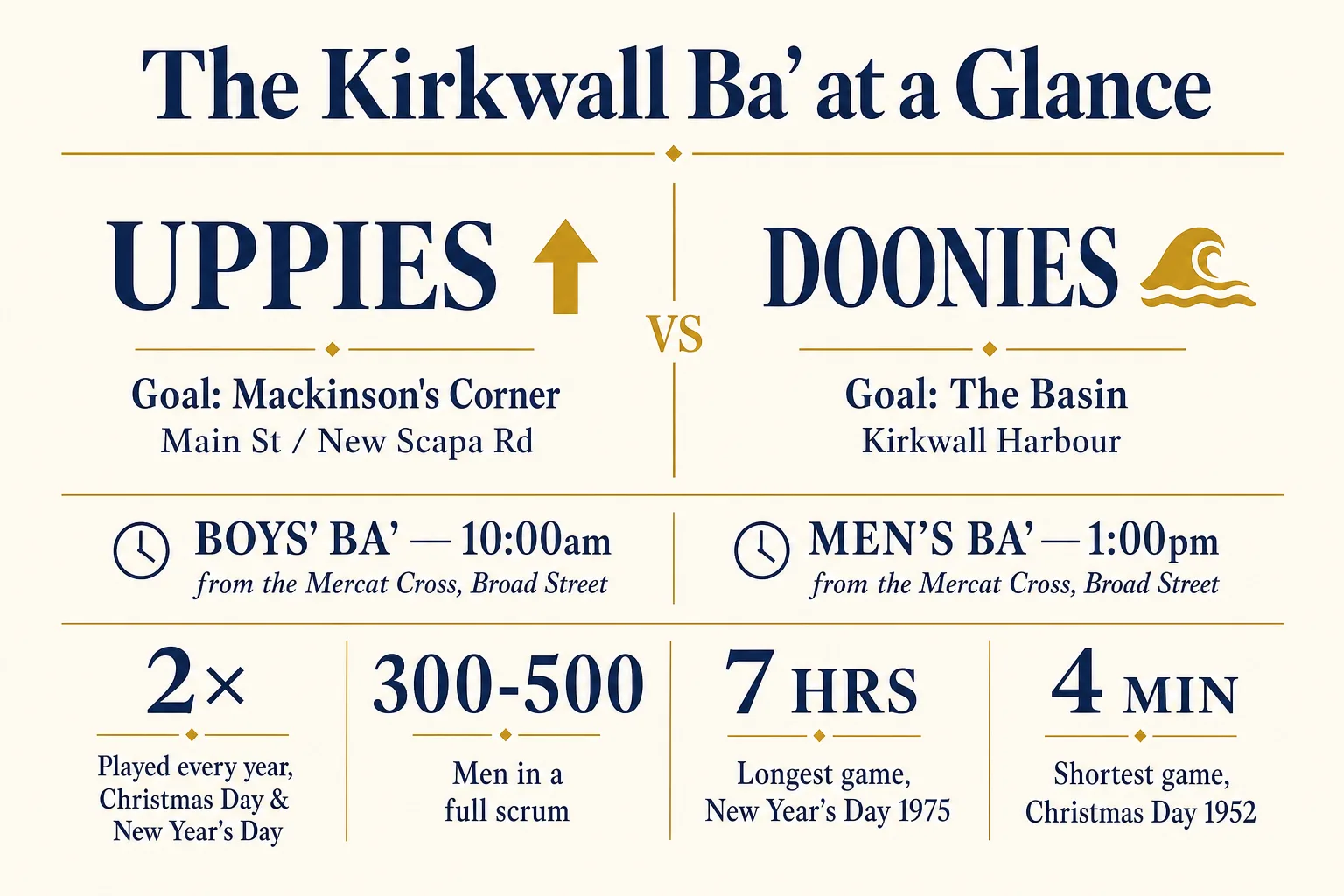
Every player in the Ba' belongs to one of two sides: the Uppies ("up the gates") or the Doonies ("doon the gates"). "Gates" is a hangover from the Old Norse gata, meaning road or path, a reminder that Kirkwall was a Norse trading town centuries before it was a Scottish burgh. Sides were traditionally fixed by which end of the old town gates you were born nearest to. That changed after Kirkwall's Balfour Hospital opened in the 1950s and almost every baby in the islands started being born in the same building, on the Uppies' side of town. Rather than end the divide, it simply shifted the logic: today, which side you play for is mostly a matter of family allegiance, passed down from parents and grandparents, or — for someone with no Ba' history at all — decided informally by which direction they first walked into Kirkwall.
There's no membership card and no sign-up sheet. You are an Uppie or a Doonie the way you're a supporter of your parents' football team, and the loyalty runs just as deep across a lifetime.
How you actually win the Ba'
The Ba' has no written rulebook, no time limit and no officials on the pitch — because there is no pitch, only Kirkwall's streets, lanes and, on occasion, the harbour itself. Instead there's a single, simple objective for each side, and an unwritten code of honour that keeps several hundred men in a crush from turning into a riot.
Once the ball is goaled — Up or Doon — the winning side argues out among itself who should keep it. The choice usually falls on someone who has given the game years of honest effort rather than whoever happened to be holding the ball at the final whistle. The winner typically displays it in a window at home afterwards, a small trophy the whole town recognises.
Planning your trip
Staying overnight? Compare live prices and availability across Orkney on Booking.com.
Compare Orkney staysWe earn a small commission if you book through this link, at no extra cost to you.
When and where the Ba' is played
The Ba' is played twice a year: on Christmas Day and New Year's Day. If either date falls on a Sunday, the game moves to the following day instead. It has only been interrupted twice in modern times — suspended through both World Wars, and cancelled again for the Christmas 2020 and New Year 2021 games and the following season because of Covid, returning in December 2022. Both games start at the same spot — the Mercat Cross on Broad Street, right in front of St Magnus Cathedral — where a Ba' official throws the ball up into the waiting crowd to start play.
Inside the scrum
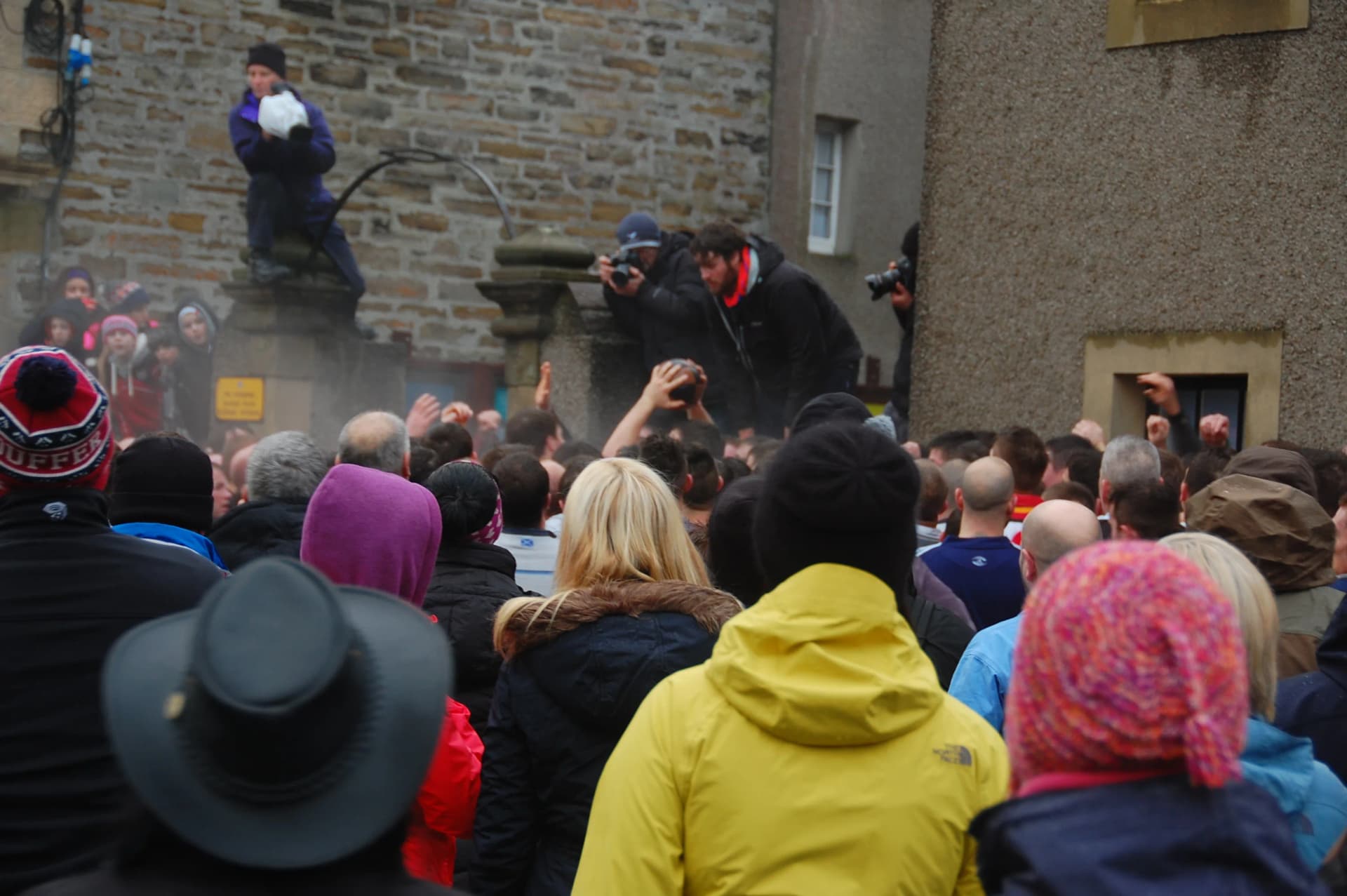
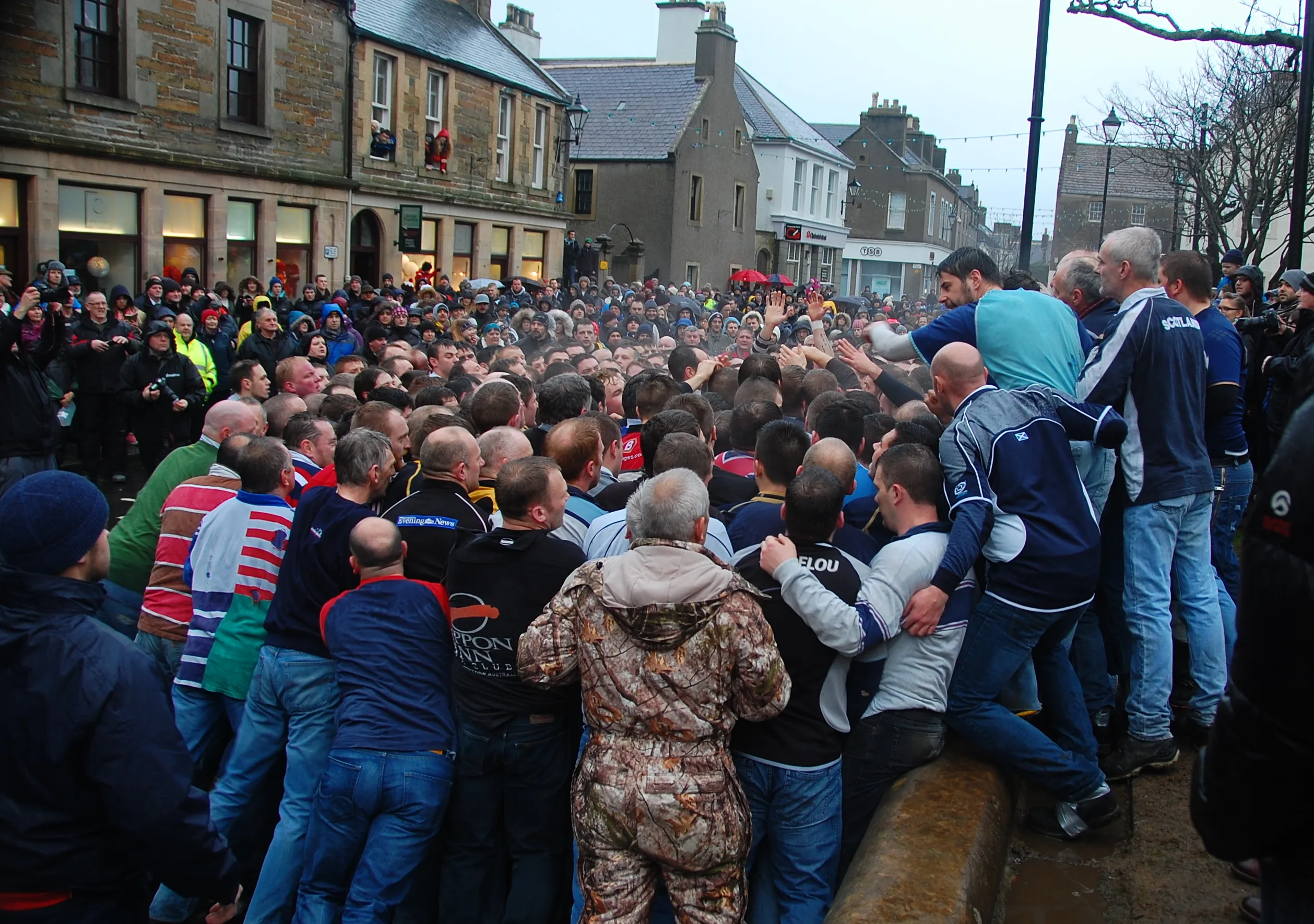
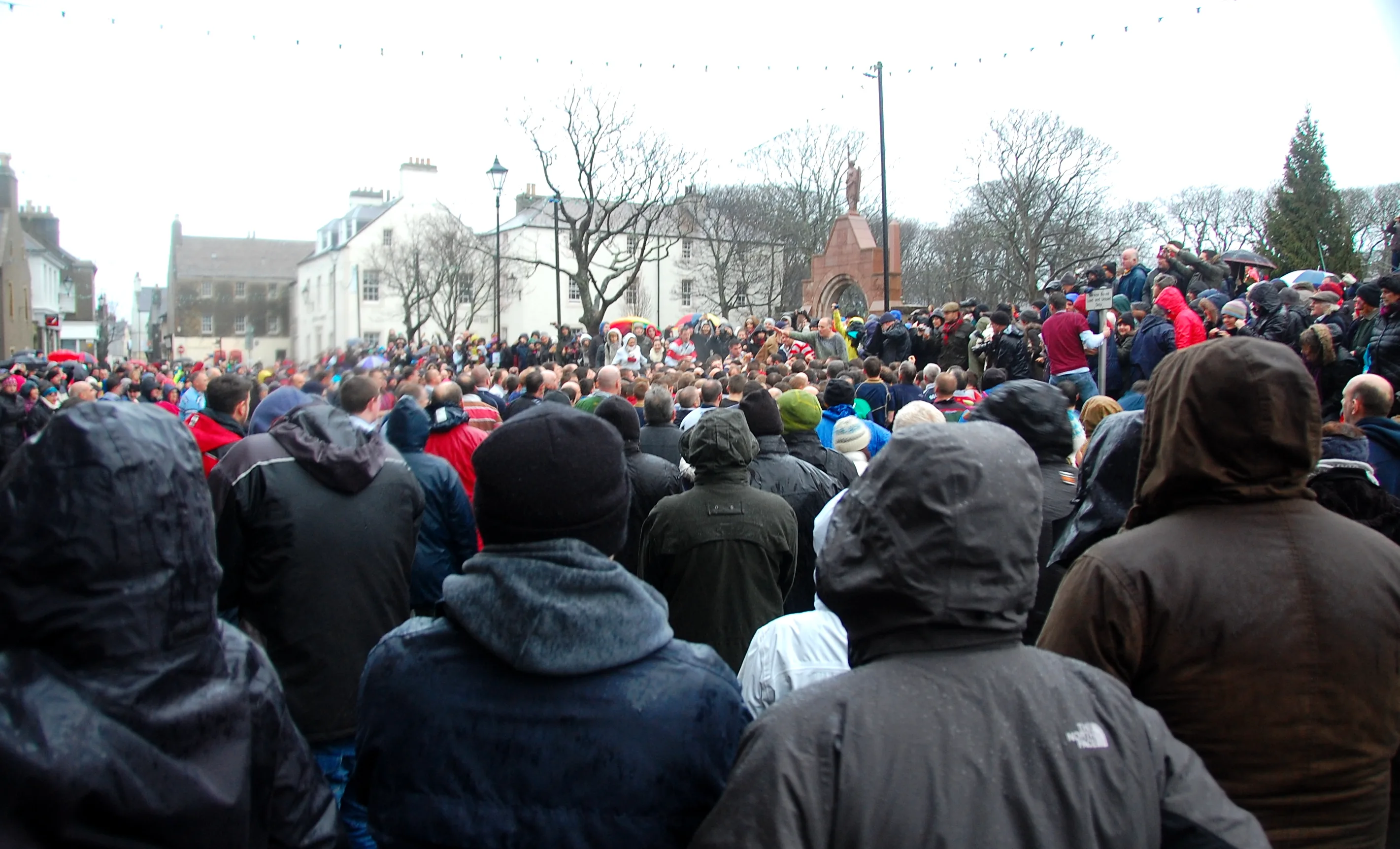
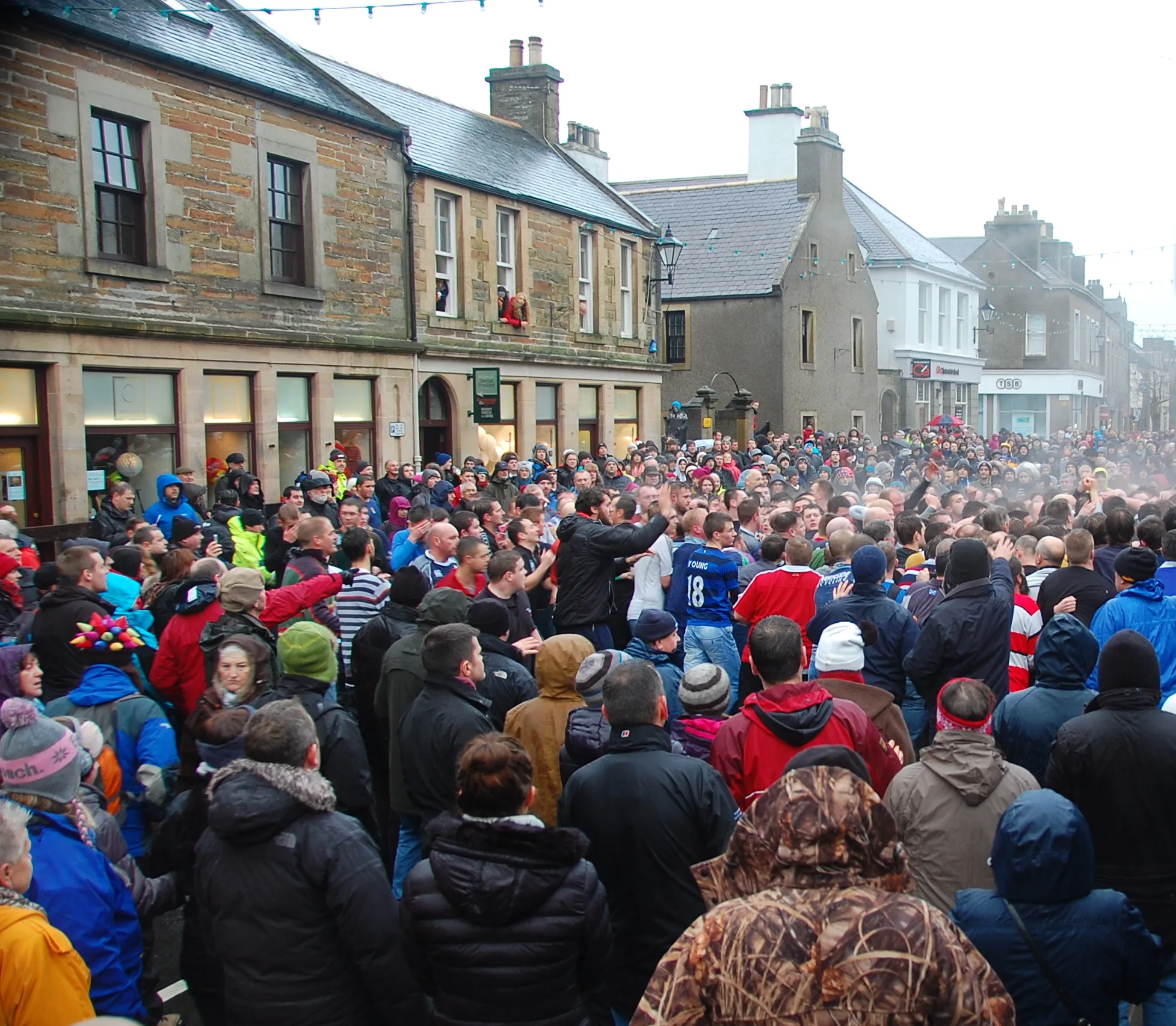
From the outside, the Ba' looks like a single, slow-moving weather front of bodies rolling down Broad Street and into the lanes off it. Inside the scrum, players describe relentless, crushing pressure from every side as the pack surges forward, stalls, and surges again — sometimes barely shifting for an hour at a time. It's rough enough that broken and cracked ribs aren't unusual, and every so often the whole scrum stops dead the moment someone goes down or loses consciousness, so they can be pulled clear safely, before play resumes exactly where it left off. That instinctive pause, with no referee to enforce it, is the clearest sign of how seriously the game's unwritten code is taken.
The town prepares for it every year. Custom-cut wooden boards, labelled and stored for reuse, go up over shop windows and doors along the route days beforehand, because the scrum will use whatever ground it's given, including the pavement in front of somebody's shopfront. Spectators are encouraged to keep back from the front edge of the crowd — the pack can turn and surge in a new direction with almost no warning, pressing those nearest it up against walls and railings.
How long a Ba' game can run
| Record | Result | Game |
|---|---|---|
| Longest Men's Ba' | 7 hours | New Year's Day, 1975 |
| Shortest Men's Ba' | 4 minutes | Christmas Day, 1952 |
| Longest Boys' Ba' | 8.5 hours | Recorded range: 4 minutes – 8.5 hours |
| Women's Ba' | Played twice, then discontinued | Christmas 1945 & New Year's Day 1946 |
Nobody can predict which kind of game they'll get. A Ba' can be over almost before the crowd has settled, or it can still be grinding through Kirkwall's lanes as the winter light fails at 4pm. That unpredictability is part of the draw for spectators — and part of the folklore for players who've spent an entire short winter's day locked in a single scrum.
Where the tradition comes from
Nobody can date the Ba' precisely. Mass street football of this kind was common across Scotland and England for at least three centuries; an account from 1797 describes football as "the principal diversion of the common people" in the region. Kirkwall's own version has picked up a colourful, almost certainly apocryphal, origin story along the way, tying it to Sigurd and the Orkneyinga Saga — the medieval chronicle of the Norse earls who once ruled these islands. Whatever the true origin, what survives today is a living tradition rather than a re-enactment: no pageantry, no costumes, just the same two goals fought over on the same streets, year after year.
The result sits alongside the islands' other deep-rooted customs covered in our first-timer's guide to visiting Orkney — proof that a place this small and this remote has kept hold of traditions most of the mainland lost generations ago.
How to watch the Ba' safely
You don't need an invitation to watch the Ba' — half of Kirkwall turns out on the street, and visitors are welcome among the crowd. A few things make it easier to enjoy without getting swept into the scrum yourself:
- Get to Broad Street early. The best vantage points near the Mercat Cross and St Magnus Cathedral fill up well before throw-up.
- Stay well back from the front of the crowd. The scrum can surge in a new direction with almost no warning, and spectators do get caught up in it.
- Dress for a long, cold stand. Warm layers, a waterproof coat and sturdy boots — a Men's Ba' can run for hours in Orkney's December weather.
- Watch your belongings. Streets this packed attract pickpockets the same as any big-city crowd.
- Expect road closures. Broad Street and the surrounding lanes close to traffic for the duration — plan to arrive on foot, which is far simpler from one of Kirkwall's small B&Bs than from a base out in the country.
Basing yourself in Kirkwall itself for the festive season means you can step out of your front door and into the crowd rather than racing the clock from further afield, and it puts you within walking distance for both the Boys' and Men's games on the same day. Christmas and New Year book up early in the town centre, so it's worth checking Orkney's accommodation options well ahead of the date if you're planning a Ba' trip.
Frequently Asked Questions
What is the Kirkwall Ba'?
A mass street football game played twice a year in Kirkwall, Orkney, on Christmas Day and New Year's Day. Two sides, the Uppies and the Doonies, try to carry a leather ball through the town's streets to their own goal, with no referee and no official rulebook.
When did the Kirkwall Ba' start?
Nobody can date it exactly. Mass street football like the Ba' was played across Scotland and England for centuries before written records began, and an 1797 account already describes football as "the principal diversion of the common people" in the area. Kirkwall's is one of several such ba' games once played in Scottish towns, though it's now among the best known and most fiercely kept.
What time does the Ba' start?
The Boys' Ba' starts at 10:00am and the Men's Ba' at 1:00pm, both thrown up from the Mercat Cross on Broad Street, in front of St Magnus Cathedral.
Who are the Uppies and the Doonies?
The two sides in the Ba'. Uppies play for the goal at Mackinson's Corner at the town's south end; Doonies play to get the ball into the sea at Kirkwall Harbour. Sides are mostly decided today by family allegiance rather than where a player was actually born.
Is the Kirkwall Ba' dangerous to watch?
It can be rough for players inside the scrum, where broken or cracked ribs aren't unheard of, but spectators who keep back from the front edge of the crowd watch safely every year. Give the pack plenty of room, since it can surge unpredictably.
Can visitors watch the Ba'?
Yes — it's a free, public event and a large share of the crowd on Broad Street each year is made up of visitors and Orcadians who no longer play. Arrive early for a good spot near the Cathedral and Mercat Cross.
How long does a Ba' game last?
Anywhere from 4 minutes to 8.5 hours. The longest recorded Men's Ba' ran for 7 hours on New Year's Day 1975; the shortest lasted just 4 minutes, on Christmas Day 1952.
Two goals, no rulebook, and a town that shutters its shop windows every December without being asked twice — the Ba' is Orkney's clearest reminder that some traditions don't need reinventing. Catch it once on Broad Street and you'll understand why Kirkwall never has.