Quick Navigation
- The Headline Historic Sites
- Skara Brae — full access to the centre, partial access to the village
- St Magnus Cathedral — ground-floor nave fully accessible
- The Orkney Museum — ramps and lift, some upper floors limited
- Maeshowe — centre accessible, cairn itself not
- Ring of Brodgar, Stones of Stenness and the Italian Chapel
- The Italian Chapel, Lamb Holm
- Getting Here — NorthLink and Pentland Ferries
- NorthLink Ferries (Aberdeen / Scrabster — Stromness & Kirkwall)
- Pentland Ferries (Gills Bay — St Margaret's Hope)
- Getting Around — Buses, Taxis, Adapted Vehicles
- Planning an Accessible Orkney Trip
- Resources & Specialist Guides
- Frequently Asked Questions
- How wheelchair friendly is Orkney overall?
- Which Orkney Neolithic sites are wheelchair accessible?
- Are the Orkney ferries wheelchair accessible?
- Can I hire a wheelchair or mobility scooter in Orkney?
- Are there accessible toilets across the islands?
- Is the Italian Chapel wheelchair accessible?
- Where should I base myself for an accessible Orkney holiday?
- Sources & further reading
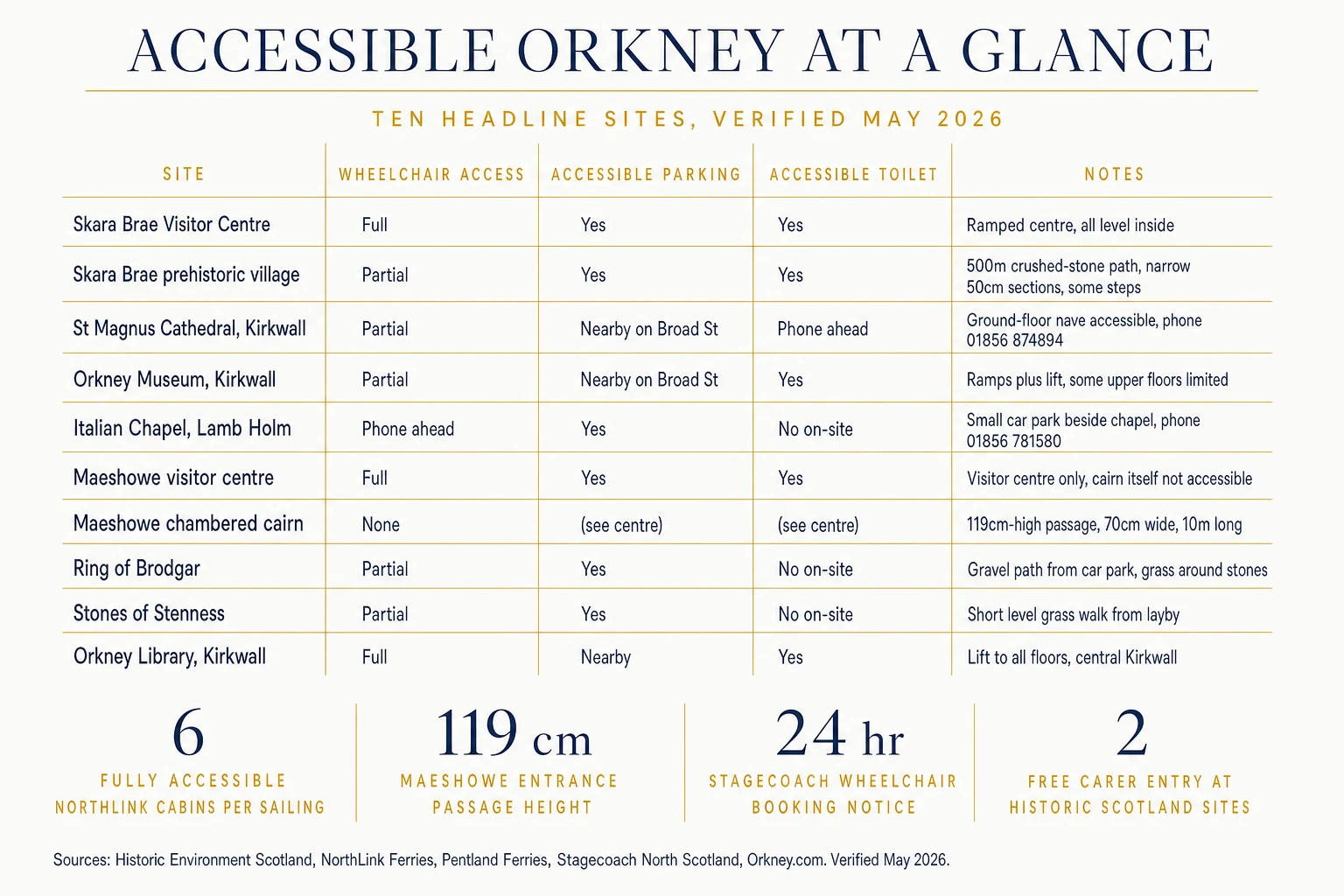
Orkney is a working archipelago of nine inhabited islands, with five-thousand-year-old monuments standing on uneven turf, two ferry routes from the mainland, and one low-floor bus network. Wheelchair users and visitors with reduced mobility will find a great deal here is genuinely accessible — and a small handful of headline sites that, honestly, are not. This guide separates the two with verified detail. Every access note below was checked against the operator's own page in May 2026.
The Headline Historic Sites
Orkney's heritage centres on a cluster of UNESCO-listed Neolithic monuments and a twelfth-century cathedral. The visitor centres have invested seriously in step-free access; the ancient monuments themselves are a more honest mix.
Skara Brae — full access to the centre, partial access to the village
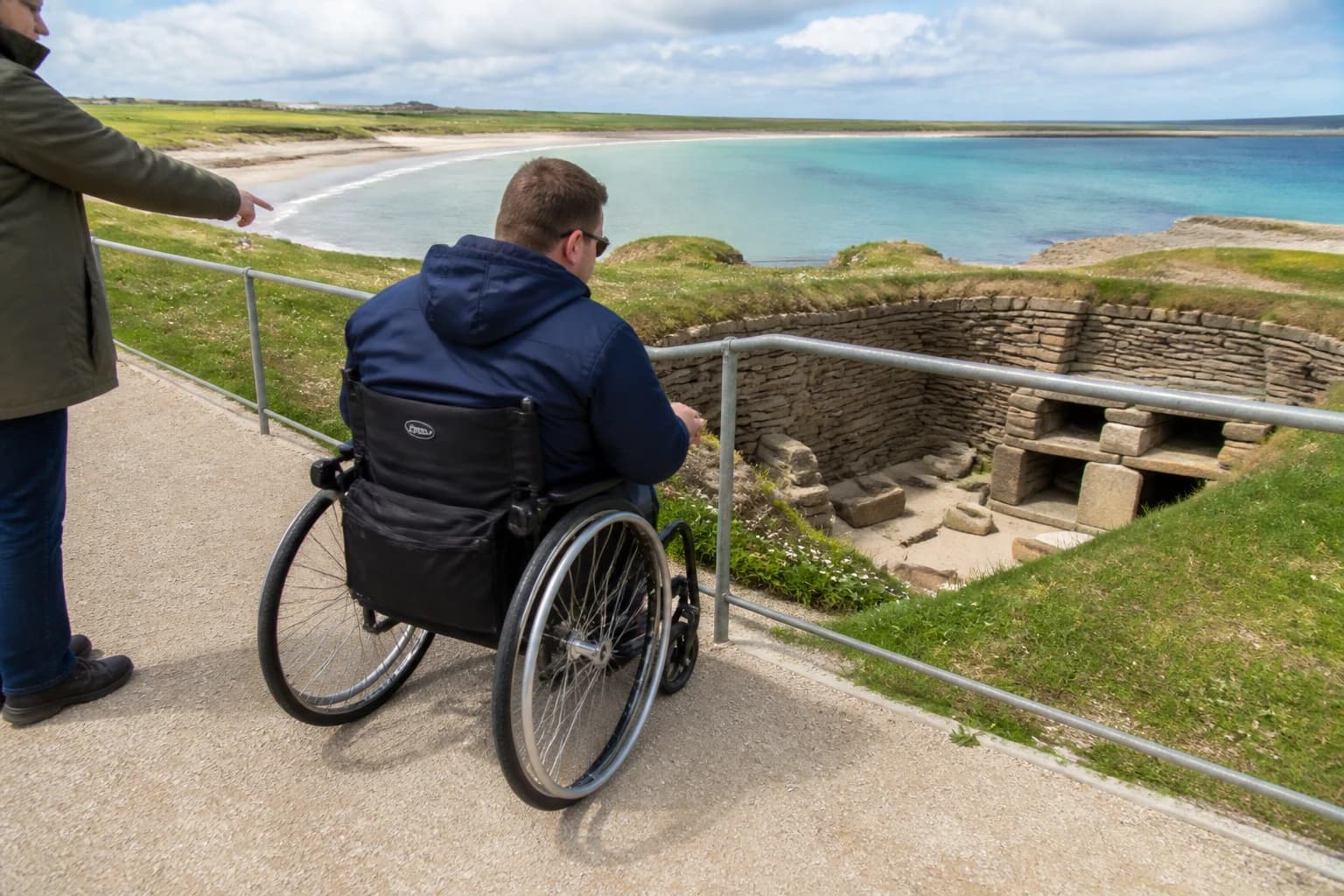
Historic Environment Scotland's own access notes describe the visitor centre as "ramped access", with "all level" interiors and "an adapted toilet". The car park is "level, tarmac surfaced... with accessible bays". From there, the path out to the prehistoric village is a 500-metre route of bound, crushed stone — mostly firm and rollable, but with sections narrowing to about 50 cm. There are steps with handrails leading to some of the side viewpoints. Staff on site can provide assistance if you call ahead, and there are two benches along the path. Free entry is provided for up to two accompanying carers per transaction.
St Magnus Cathedral — ground-floor nave fully accessible
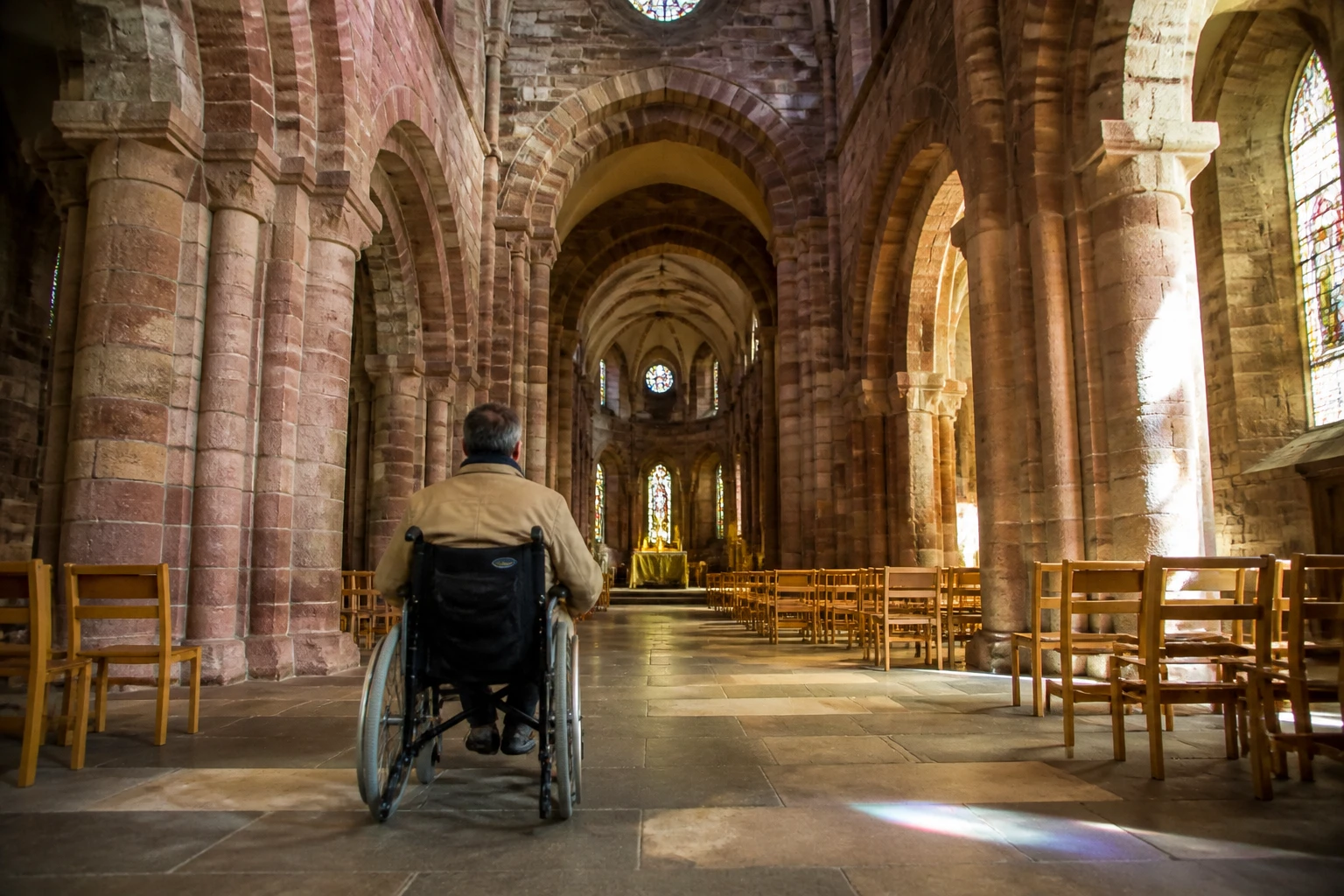
The Romanesque nave of Kirkwall's twelfth-century cathedral is largely accessible at ground floor level, with patches of original flagstone underfoot but no internal steps along the central aisle. Disabled parking is available on Broad Street nearby. The cathedral does not publish a detailed access statement online; the custodian (01856 874894) will confirm current arrangements and meet visitors at the most level entrance if asked in advance. Accessible toilet provision is limited — phone ahead.
The Orkney Museum — ramps and lift, some upper floors limited
Housed in seventeenth-century Tankerness House on Broad Street, the museum reaches most of its galleries via a combination of ramps and a passenger lift, so the Stone Age, Pictish, Norse and twentieth-century displays are all accessible. A small number of upper rooms in the historic wing remain stepped — staff will route visitors to alternative entrances. Entry is free, with accessible toilets on site.
Maeshowe — centre accessible, cairn itself not
The Maeshowe visitor centre at Stenness, opened 2017, has accessible parking on level tarmac and is fully accessible internally. The five-minute shuttle bus to the monument "can accommodate a wheelchair", but the cairn itself is honestly out of reach: the entry passage is 119 cm high and 70 cm wide and runs 10 metres on a flagstone floor — Historic Environment Scotland states plainly that the passage is "unsuitable for wheelchairs". The 400-metre approach path from the coach stop is also gravel-and-grass with a 1:5 gradient near the top. Watch the audio-visual interpretation in the centre instead. Our wider guide to the Heart of Neolithic Orkney sets out which UNESCO sites work for which visitors.
Ring of Brodgar, Stones of Stenness and the Italian Chapel
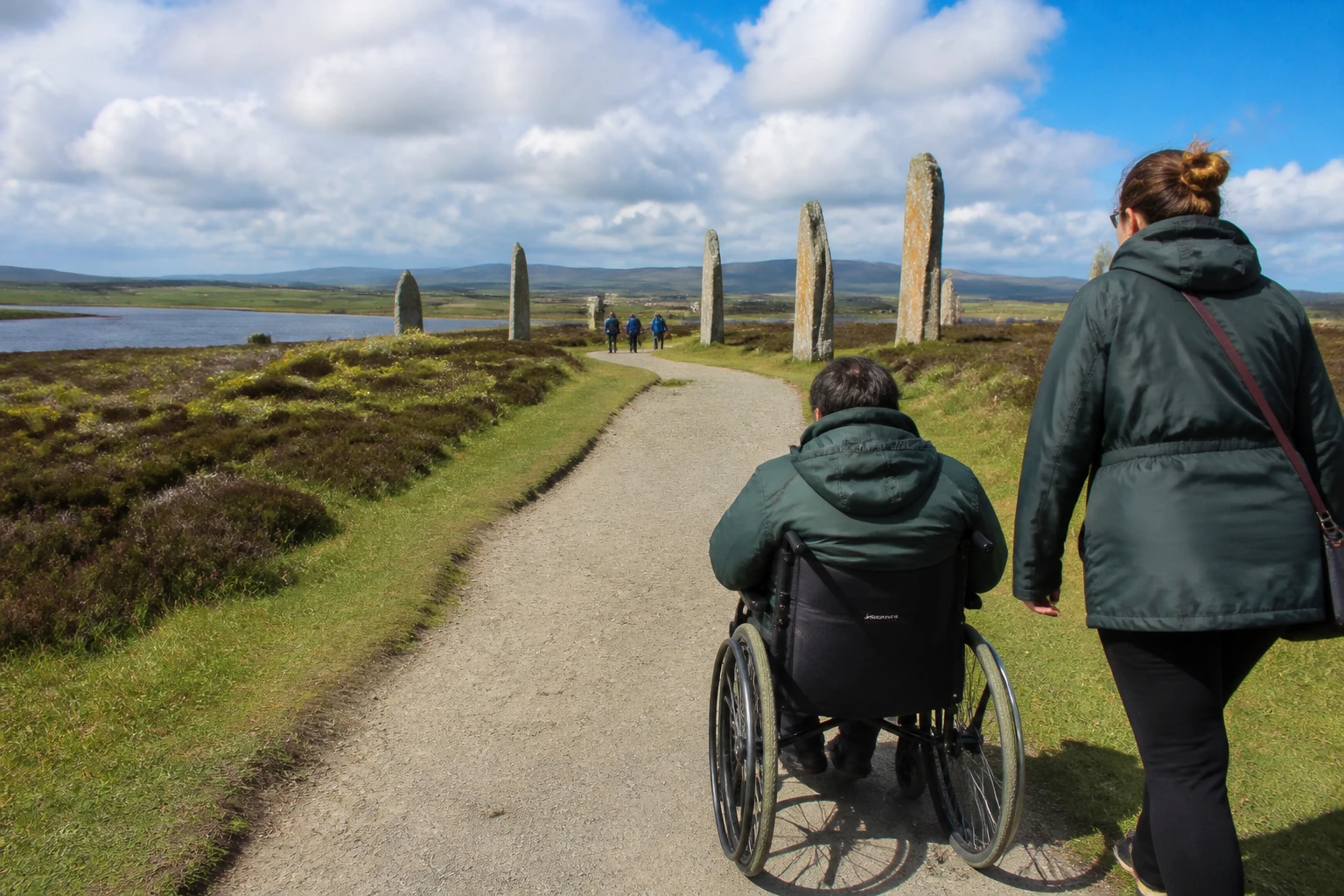
The two great stone circles are free to visit, open year-round, and partially manageable. At the Ring of Brodgar, a firm gravel path runs from the car park down a slight slope to the ring; once you arrive, the path around the inside of the circle transitions to short-mown grass. Many wheelchair users complete the full loop in dry conditions; assistance is often needed for the grass section. The nearby Stones of Stenness is a shorter, flatter approach — a level grass walk of about 50 metres from the layby.
The Italian Chapel, Lamb Holm
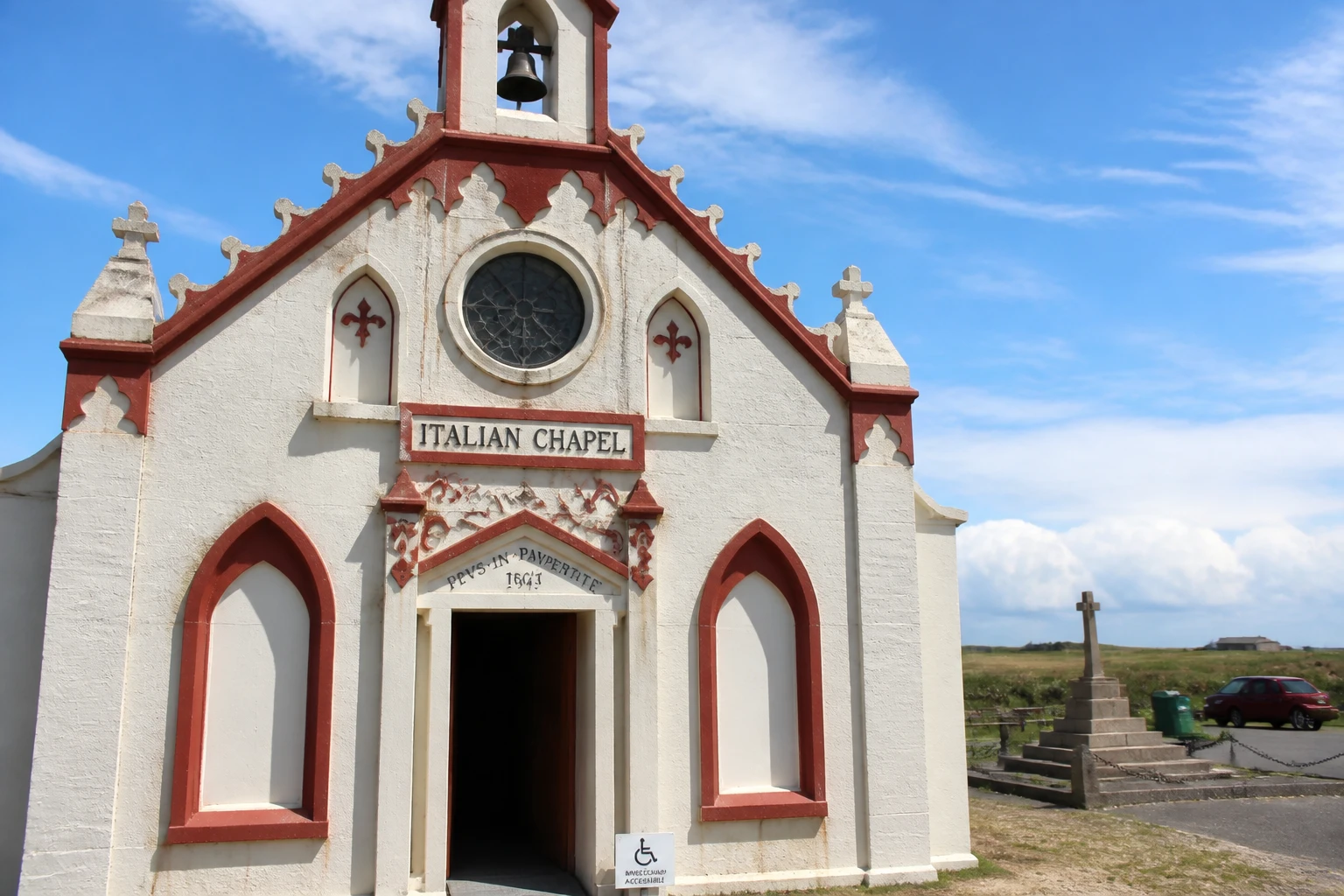
The Italian Chapel — built by Italian prisoners of war in 1943 from two Nissen huts and detailed in our Scapa Flow and WWII guide — sits next to its own small visitor car park, with the doorway only metres from the disabled bay. There is a low concrete threshold at the entrance and a single small step into the chancel inside; many wheelchair users access the main interior without difficulty. No accessible toilet is provided on site, and there is none we can currently confirm as open nearby — plan your toilet stop around a staffed attraction before you set off. Phone the chapel direct on 01856 781580 to confirm current arrangements.
Planning your trip
Staying overnight? Compare live prices and availability across Orkney on Booking.com.
Compare Orkney staysWe earn a small commission if you book through this link, at no extra cost to you.
Getting Here — NorthLink and Pentland Ferries
Both operators publish full mobility-assistance pages and offer step-free boarding via lifts. The detail differs.
NorthLink Ferries (Aberdeen / Scrabster — Stromness & Kirkwall)
NorthLink runs three ships: MV Hjaltland and MV Hrossey on the overnight Aberdeen route, and MV Hamnavoe on the daytime Scrabster — Stromness crossing. Each of the two Aberdeen vessels has four accessible cabins: three sleeping two (two standard, one premium) and one fitted with a hoist sleeping three. Hamnavoe has two: one standard sleeping three and one with a hoist sleeping two. All ports and ships have lifts. NorthLink uses the WelcoMe disability service platform for tailored assistance, and asks that you reserve a parking space next to the car-deck lift when you book.
Pentland Ferries (Gills Bay — St Margaret's Hope)
The catamaran MV Alfred is the more frequent option, with a 1 hour 10 minute crossing three times daily. It has a wheelchair lift from the car deck up to the cafe and lounge. The older MV Pentalina has a chair stair lift rated to 120 kg (265 lbs) for self-transferring users only. Mobility passengers should inform Pentland Ferries customer services at the booking stage so the car is positioned correctly, and check in 45 minutes before departure. Late arrivals may not be accommodated.
Getting Around — Buses, Taxis, Adapted Vehicles
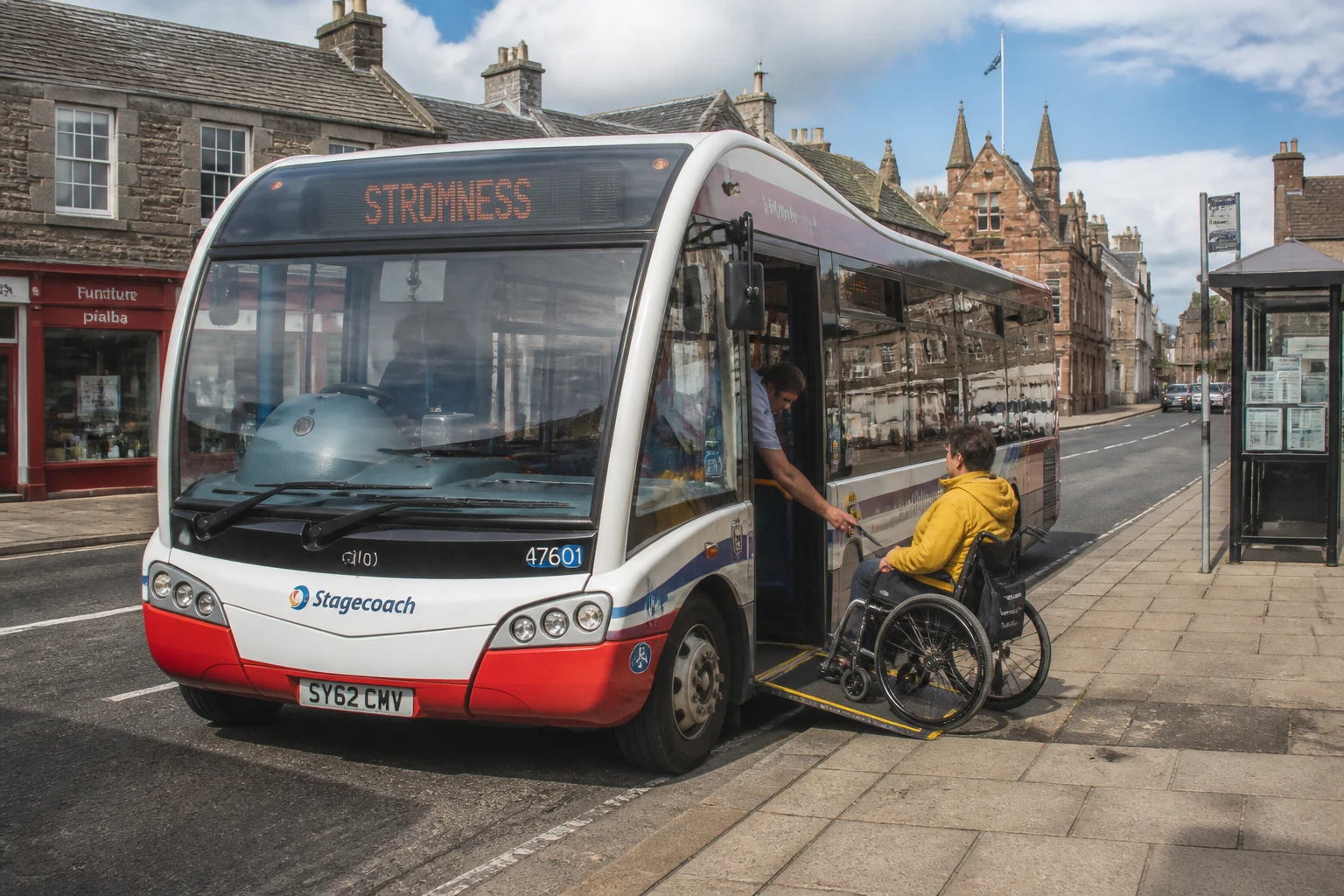
Stagecoach North Scotland operates Orkney's public buses, and states that all services are fully wheelchair accessible — low-floor easy-access vehicles run the main routes. The headline service is the X1 Kirkwall — Stromness route, with departures roughly every half-hour through the middle of the day, Monday to Saturday. Wheelchair-accessible journeys require 24 hours notice; book on 01856 870555 when planning. For visitors leaving the car behind entirely, our companion guide on getting around Orkney without a car sets out the bus, taxi and ferry network in full.
Accessible taxis are available across Mainland Orkney but in limited numbers; book well in advance, especially during summer cruise-ship arrivals. For longer trips or for several wheelchair users travelling together, bringing or hiring an adapted vehicle through a Glasgow- or Inverness-based specialist remains the most flexible option. Mobility scooter and wheelchair hire on the islands is short-supply — the British Red Cross local branch is the usual route, with several weeks of notice.
Planning an Accessible Orkney Trip
A three-day no-stairs itinerary that works well: Day one, Kirkwall on foot — St Magnus Cathedral, the Orkney Museum, lunch in town, the Strynd accessible toilet and the library; Day two, west by car or accessible taxi to Skara Brae and the Stones of Stenness, with the Brodgar gravel loop in the afternoon; Day three, the Italian Chapel and the Churchill Barrier viewpoints in the morning, the Pier Arts Centre Stromness in the afternoon. For first-timers who want help building the wider plan around access, our first-timer's guide to visiting Orkney covers timing, weather and the major bookings.
Resources & Specialist Guides
- Euan's Guide — user-reviewed access guides for UK venues including the Ring of Brodgar, Stromness and several Kirkwall venues.
- Historic Environment Scotland accessibility hub — full access notes for every staffed monument including Skara Brae and Maeshowe.
- NorthLink Ferries accessibility and Pentland Ferries mobility FAQ.
- VisitScotland inclusive accommodation — filterable listings of properties with wet rooms, hoists and step-free entry.
Frequently Asked Questions
How wheelchair friendly is Orkney overall?
The visitor infrastructure is genuinely good. Stagecoach buses are fully low-floor, both ferry operators offer step-free boarding via lifts and provide accessible cabins, and the visitor centres at Skara Brae, Maeshowe and the Orkney Museum are level inside. The original Neolithic monuments themselves are a more mixed picture: the Ring of Brodgar and Stones of Stenness are largely manageable; Maeshowe's 119 cm-high entrance passage is not. Kirkwall and Stromness town centres have accessible pavements and accessible toilets at the main car parks.
Which Orkney Neolithic sites are wheelchair accessible?
The visitor centres at Skara Brae and Maeshowe are fully accessible. The Skara Brae viewing path is partially accessible — firm bound-gravel surface but with sections narrowing to about 50 cm and steps to some viewpoints. The Ring of Brodgar has a firm gravel approach from the car park and a short-grass loop inside the circle. The Stones of Stenness is the easiest — a short level grass walk from the layby. Maeshowe itself is not wheelchair accessible: the entrance passage is 119 cm high and 70 cm wide.
Are the Orkney ferries wheelchair accessible?
Yes. NorthLink's MV Hjaltland, MV Hrossey and MV Hamnavoe all have lifts and dedicated accessible cabins (some fitted with hoists). Pentland Ferries' flagship MV Alfred has a wheelchair lift between the car deck and the lounge. Both operators ask that you flag your requirements at booking — NorthLink via the WelcoMe service, Pentland Ferries via customer services — so vehicles can be parked next to the lift and pre-boarding arranged.
Can I hire a wheelchair or mobility scooter in Orkney?
Short-term wheelchair loans are offered by the British Red Cross's Orkney branch, subject to availability — book well in advance, ideally several weeks before travel. There is no commercial mobility-scooter hire operating on the islands at scale; bringing your own equipment is the more reliable option. Some accessible holiday-let properties include a hoist or shower wheelchair in the let — ask the host directly.
Are there accessible toilets across the islands?
Yes in the main towns and at staffed attractions. Accessible toilets are available at Kirkwall harbour, the Travel Centre, the Pickaquoy Centre, the Orkney Library, Stromness harbour, the Skara Brae visitor centre, the Maeshowe visitor centre, the Orkney Museum, the airport, and most ferry terminals. Provision is limited at unstaffed monuments — plan toilet stops around the staffed sites.
Is the Italian Chapel wheelchair accessible?
Largely yes, with a caveat. The Italian Chapel sits a few metres from its own disabled bay, and the main interior is reached over a single low threshold and one small step into the chancel. No accessible toilet on site, and none we can currently confirm as open nearby — plan your toilet stop around a staffed attraction before you set off. Phone 01856 781580 ahead of a visit to confirm whether a custodian is on duty.
Where should I base myself for an accessible Orkney holiday?
Central Kirkwall is the most practical base — it is the bus and ferry hub, has the highest density of accessible accommodation, and puts the cathedral, museum, library and the airport bus within easy reach. Stromness is a smaller, prettier option with the Pier Arts Centre and the Hamnavoe ferry to Scrabster, though the historic centre's cobbled flagstones are uneven in places.
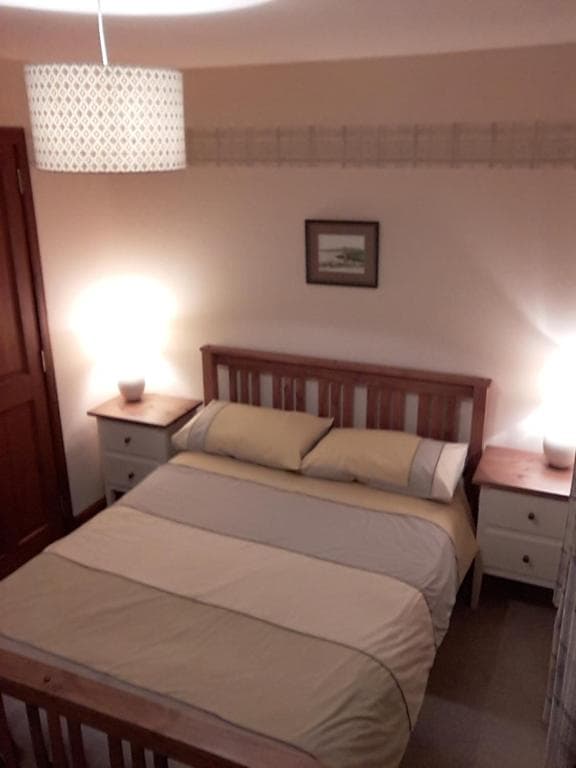
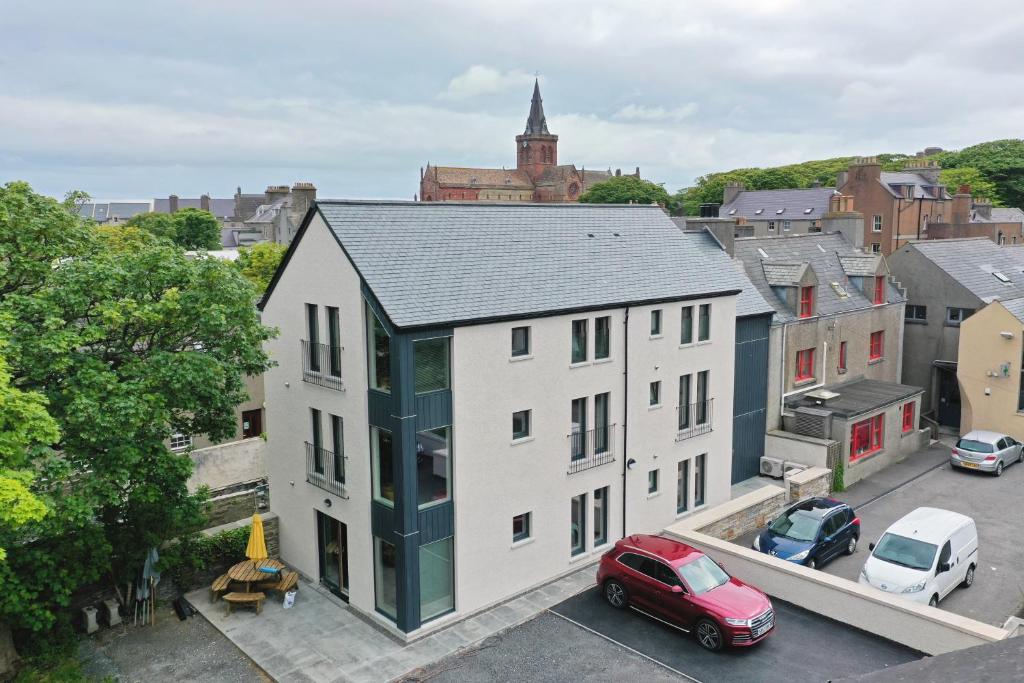
Orkney is one of the most rewarding accessible destinations in the British Isles — not because every site is perfect, but because the operators publish honest access notes, the staff phone you back, and the practical infrastructure (buses, ferries, visitor centres) genuinely works. Book accommodation early, phone every venue you plan to visit, allow extra time at the door, and the islands will pay you back tenfold. One thing our own listings cannot tell you is how a property handles access. We hold no step-free or bathroom information, so treat the Orkney properties we list as a starting point and ask the owner directly about entry, doorway widths and bathroom layout before you book.
Sources & further reading
The facts in this guide were checked against the following authoritative sources.
- Accessibility Options — NorthLink Ferries — accessible cabin counts
- Orkney Public Bus Guide Summer 2025 — Orkney Islands Council — X1 bus frequency
- Italian Chapel — VisitScotland Travel Trade — chapel step/ramp access
- Maeshowe Chambered Cairn — Historic Environment Scotland — site access details
- Orkney — Euan's Guide — disabled visitor reviews