Quick Navigation
- Why Orkney Punches So Far Above Its Weight for Birders
- The Eight Species Most Visitors Come For
- Atlantic Puffin (Fratercula arctica) — IUCN VULNERABLE
- Hen Harrier (Circus cyaneus) — UK RED LISTED
- Short-eared Owl (Asio flammeus) — Locally "Cattie-face"
- Seabird Cities — Gannet, Guillemot, Razorbill, Kittiwake, Fulmar
- Arctic Tern (Sterna paradisaea) — Champion Migrant
- Great Skua "Bonxie" (Stercorarius skua)
- Red-throated Diver (Gavia stellata)
- Wintering Wildfowl — Whooper Swan, Greylag, Wigeon
- The Working Map — Where to Actually Go
- Planning the Visit — Best Months, Kit, and Etiquette
- Kit and etiquette
- Frequently Asked Questions
- When is the best time to go birdwatching in Orkney?
- Where are the best places to see puffins in Orkney?
- How many Hen Harriers live in Orkney?
- Is the Atlantic Puffin endangered?
- How many RSPB reserves are there in Orkney?
- Do I need to book or pay to visit Orkney's RSPB reserves?
- Sources & further reading
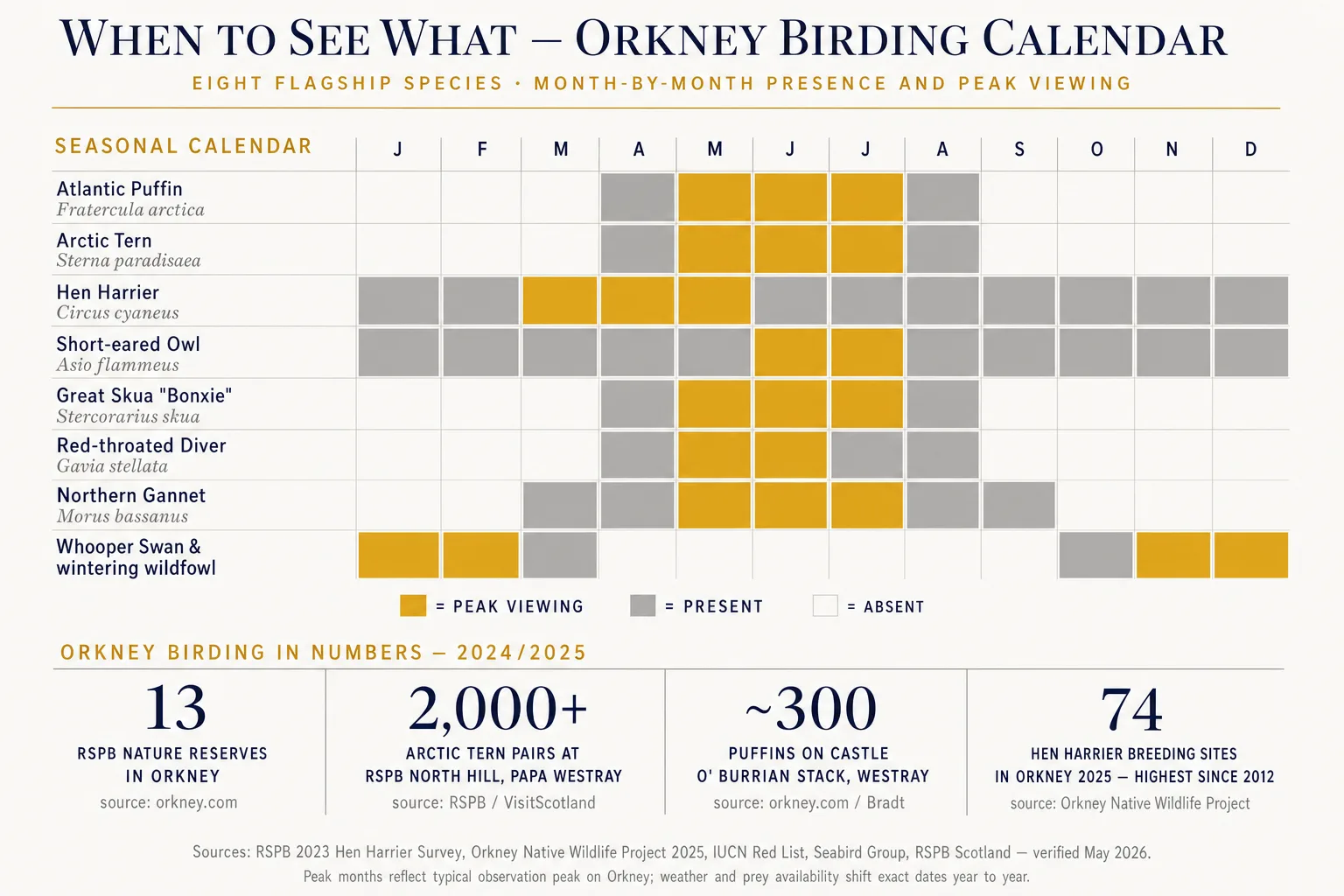
Orkney is a working seabird metropolis. Thirteen RSPB reserves, more than 2,000 Arctic Tern pairs on a single Papa Westray headland, roughly 300 puffins crammed onto the Castle o' Burrian stack each summer, and a hen harrier population that quietly rebounded to 74 confirmed breeding sites in 2025 — the highest since 2012. This is the 2026 month-by-month guide: which species, which reserve, which window, and the verified numbers behind each one.
Why Orkney Punches So Far Above Its Weight for Birders
The numbers do most of the work. Orkney holds 13 RSPB nature reserves across roughly seventy islands, hosts one of the UK's largest Arctic Tern colonies, supports one of three regional strongholds for breeding Hen Harriers, and packs three internationally important seabird cities — Marwick Head, Noup Cliffs and Mull Head — onto a coastline you can drive end-to-end in an afternoon. Add in the Orkney vole (an endemic prey species absent from mainland Britain), low light pollution, and short transport hops between reserves, and the result is a wildlife landscape that punches well above its modest geography.
The Eight Species Most Visitors Come For
This is the working shortlist — eight birds that, in season, you can reasonably expect to see if you turn up in the right place at the right hour. The infographic above tells you when; the rest of this section tells you where.
Atlantic Puffin (Fratercula arctica) — IUCN VULNERABLE
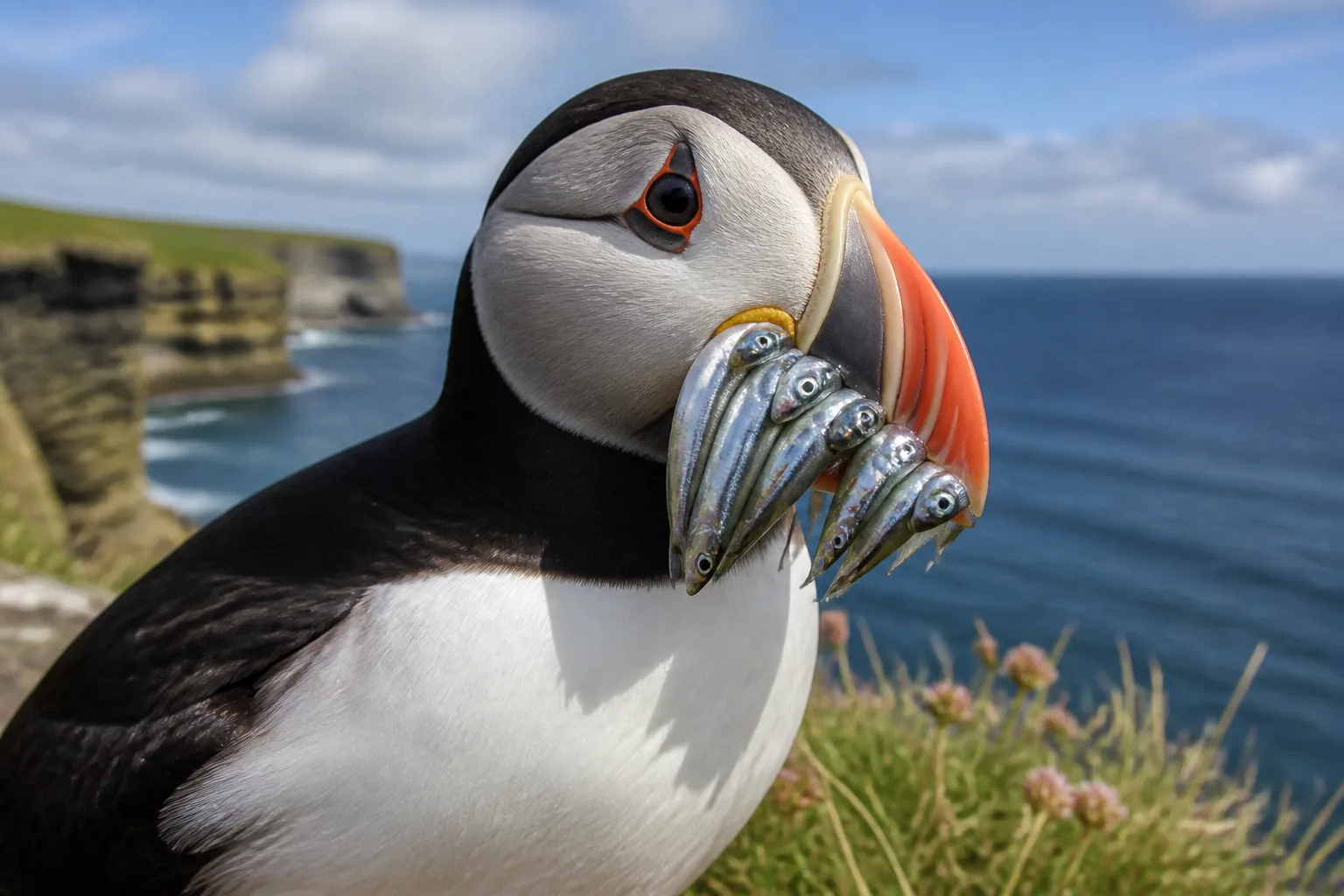
Puffins arrive on the Orkney cliffs in April and leave by early August, with peak viewing from mid-May to mid-July. Globally, they are now listed as Vulnerable on the IUCN Red List — populations have crashed across parts of their range due to climate-driven shifts in sand-eel availability, plastic ingestion and predator pressure. That makes a healthy Orkney colony genuinely worth visiting.
- Castle o' Burrian (Westray): Orkney's largest puffin colony — around 300 birds visible on and around the stack at any one time in peak season. Short cliff-edge walk from the road; viewing is from the headland, not the stack itself.
- Brough of Birsay (Mainland): Tidal-island walk timed to low water; small but very approachable colony on the west cliffs. Check tide tables before you set out — the causeway floods.
- Marwick Head (Mainland): Puffins in smaller numbers but combined with kittiwakes, guillemots and razorbills — the most accessible seabird-city experience on Mainland Orkney.
| Spot | Where | Best months | Why go / access |
|---|---|---|---|
| Castle o' Burrian | Westray | May–Jul (late Apr–early Aug) | Orkney's largest colony — ~300 birds on the sea stack. Short cliff walk; view from the headland. |
| Marwick Head (RSPB) | West Mainland | Mid-May–Jul | Most accessible — short walk from the car park, puffins among kittiwakes & guillemots. |
| Brough of Birsay | West Mainland | Late May–Jul | Small, approachable colony on the far cliffs. Cross the tidal causeway near low water. |
| Noup Head (RSPB) | Westray | May–Jul | Puffins among gannets on the west cliffs by the 1898 lighthouse. Longer walk from the road end. |
| RSPB Hoy | Hoy | Jun–Jul | Puffins on the cliffs near the Old Man of Hoy. Combine with the famous sea-stack walk. |
Hen Harrier (Circus cyaneus) — UK RED LISTED
Orkney is one of three regional strongholds for Scotland's breeding Hen Harriers, alongside the west Highlands and the Outer Hebrides. The most recent national survey (2023) put Scotland at 529 territorial pairs — 77% of the UK and Isle of Man total of 653 — and Orkney's local population has been rebounding strongly. The Orkney Raptor Study Group confirmed Hen Harriers breeding in 74 locations in 2025 on the islands where stoats are present, the highest number since 2012, as the Orkney Native Wildlife Project's long-running stoat-eradication programme restores the vole base.
The thing to come for is the sky-dance: from late March through May, ghostly grey males climb hundreds of feet over moorland, plunge in a series of stomach-dropping U-shapes, pull up, climb and repeat. It is one of British nature's stranger and more theatrical courtship rituals.
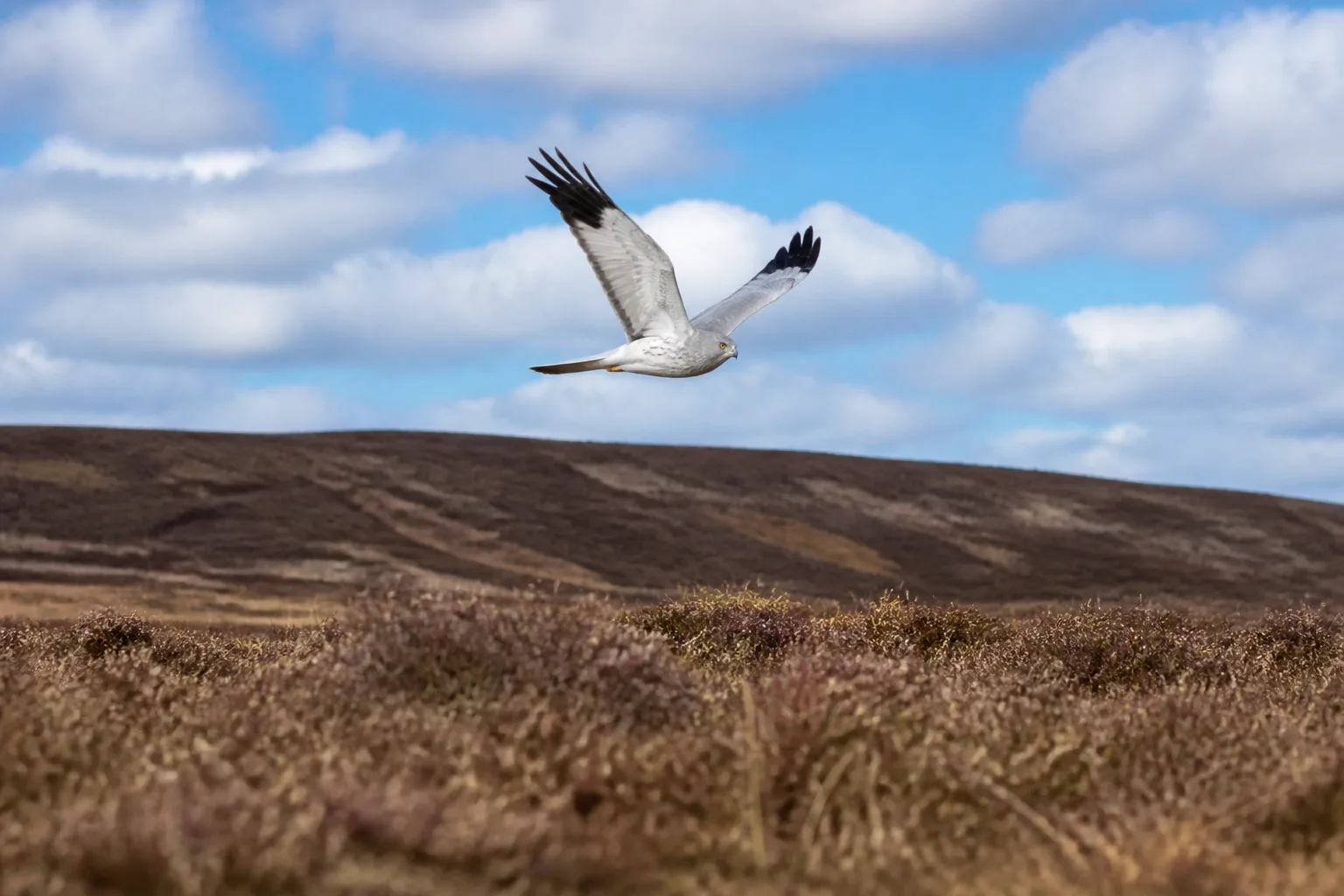
- RSPB Cottascarth & Rendall Moss (Mainland): Dedicated wooden hide built specifically for harrier viewing. Bring patience and a flask.
- RSPB Birsay Moors (Mainland): Larger moorland, viewable from roadside pull-ins as well as the marked path. Also good for Merlin and Red-throated Diver.
- RSPB Hobbister (Mainland): A working blanket bog reserve south of Kirkwall — quieter, lower-pressure viewing of both Hen Harrier and Short-eared Owl.
Short-eared Owl (Asio flammeus) — Locally "Cattie-face"
Unusually for an owl, Orkney's "Cattie-faces" hunt by day, especially in June and July when chicks demand a steady food supply and adults are forced to fly through the daylight hours. They quarter low over moorland and rough grazing, dropping suddenly on Orkney voles. Scan fence posts and dry-stone-dyke tops on Hobbister, Trumland (Rousay) and the moorland fringes of Birsay.
Seabird Cities — Gannet, Guillemot, Razorbill, Kittiwake, Fulmar
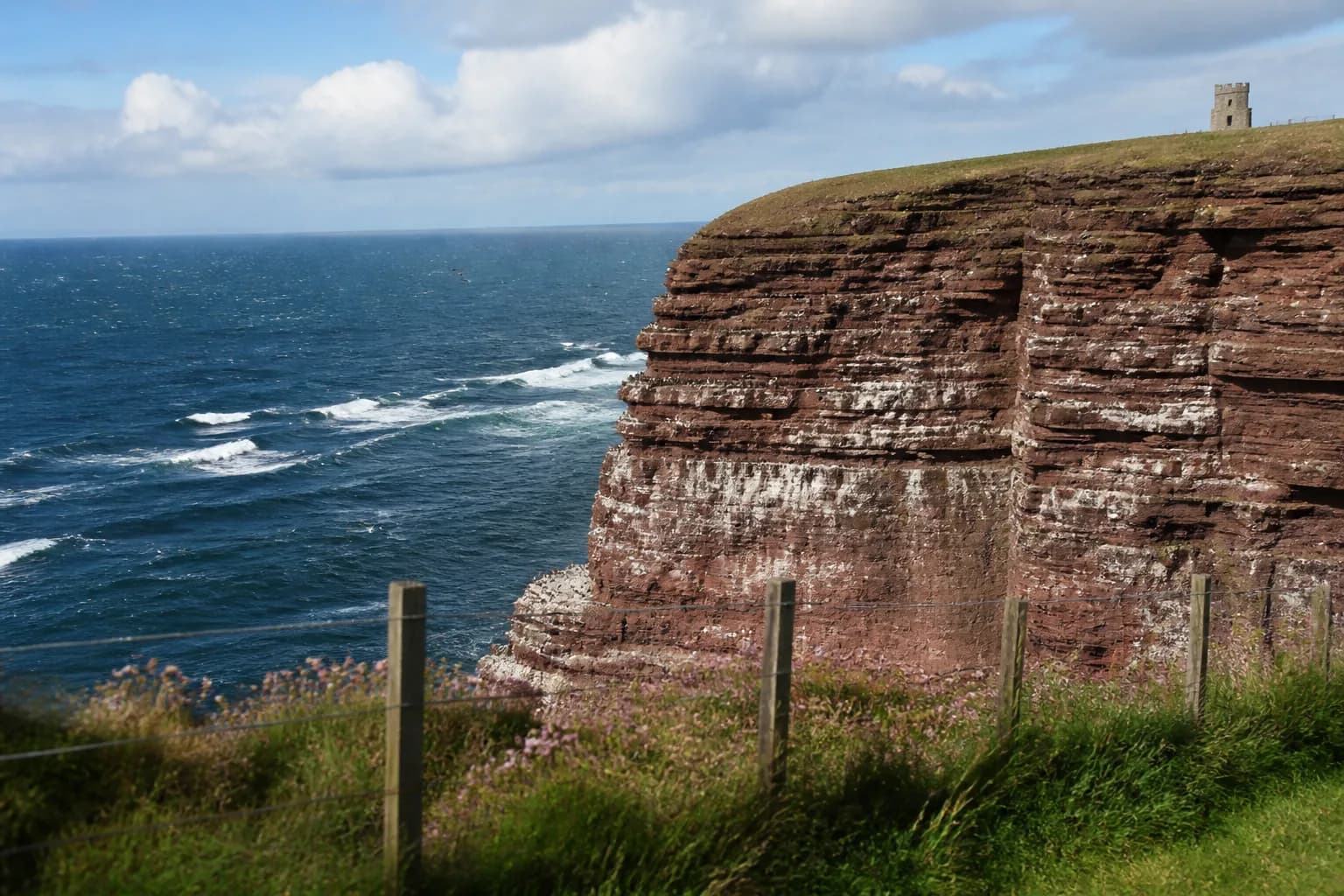
From May to early August, three Orkney coastlines transform into seabird cities — Marwick Head and Mull Head on the Mainland, and Noup Cliffs on Westray. Kittiwakes here have been among the hardest hit: an RSPB full colony count reported in October 2011 found overall seabird numbers at Marwick Head down a staggering 53% on the 2000 UK census, and 22% down again on the previous count in 2006. The colonies are still spectacular, but the decline is part of what makes responsible viewing matter.
Noup Cliffs on Westray, meanwhile, holds one of Britain's youngest gannetries — gannets only began nesting there in 2003 and the colony has grown to around 1,500 breeding pairs, an outlier story in an otherwise grim seabird decade. It is a fraction of Bass Rock’s 75,000 pairs; what makes it remarkable is the direction of travel. For the wider context on Orkney's dramatic coastlines and which cliffs hold which colonies, the sea-cliffs guide covers the geology and access in more detail.
Arctic Tern (Sterna paradisaea) — Champion Migrant
Few birds in the world have a stronger migration credential. Arctic Terns flying into Orkney each spring have completed a one-way journey of around 22,000 miles from their Antarctic wintering grounds — one of the longest migrations of any animal on Earth. They arrive in late April, are at full breeding pitch through May, June and July, and have largely left by early August.
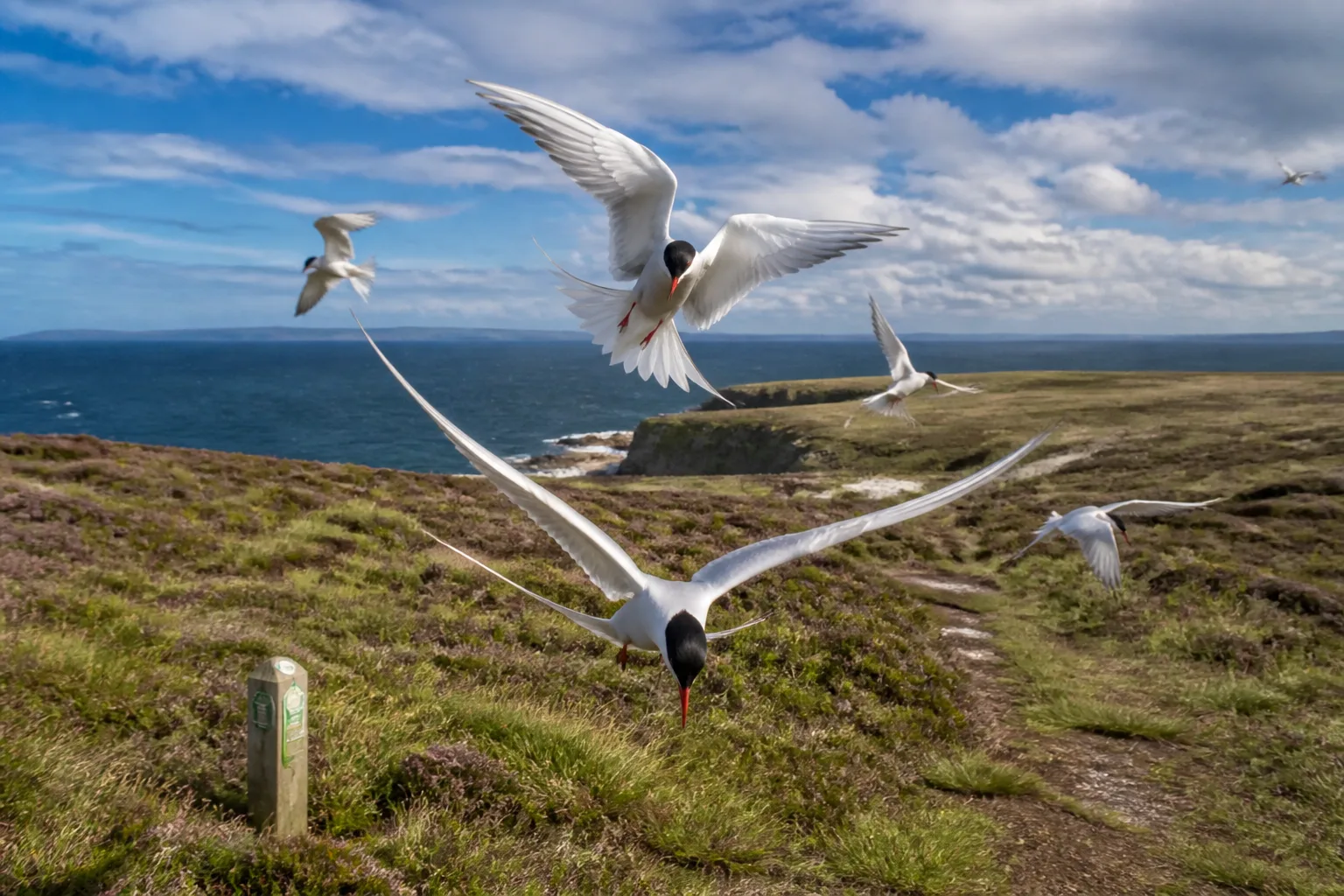
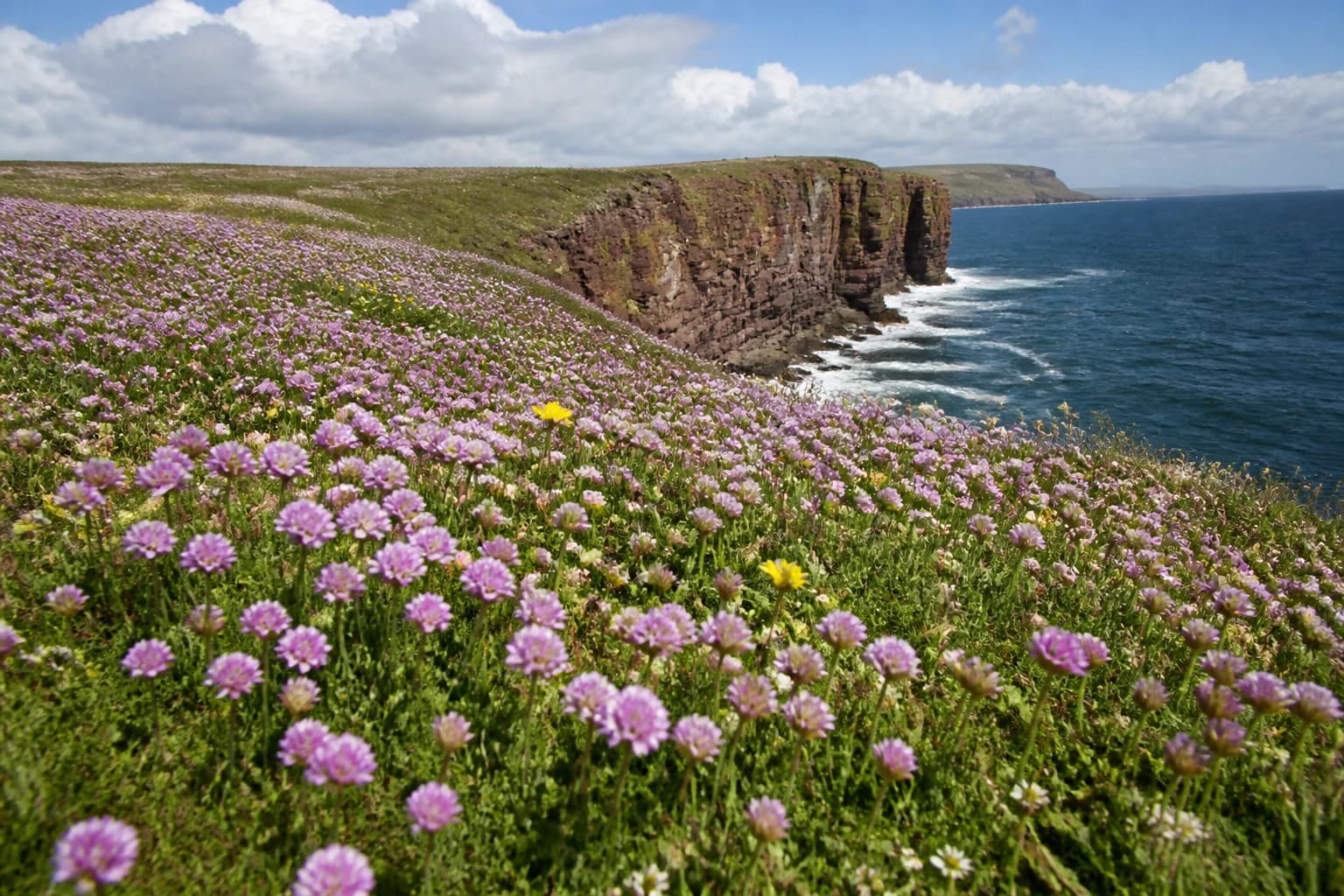
The flagship site is the North Hill RSPB reserve at the north end of Papa Westray, which holds over 2,000 breeding pairs — one of the largest Arctic Tern colonies in Britain — plus nationally important numbers of Arctic Skua, Scottish Primrose in bloom, and a small densely-packed seabird ledge on the east coast. The reserve is open access on a single waymarked path; terns dive-bomb anything tall during the breeding season, so the RSPB recommends a stick held above the head — they strike the highest point, not your face. For the wider Papay context — the famous flight, the Knap of Howar, and how to actually get there for a day trip — see the dedicated Papa Westray guide.
Great Skua "Bonxie" (Stercorarius skua)
Britain's most aggressive seabird — barrel-chested, brown, and very willing to clatter walkers who stray too close to a nest. Hoy and the smaller North Isles hold significant populations, breeding May through August. The species took a severe knock from avian influenza in 2021-22 and remains on the UK Amber list, but Orkney's territories are still very much active.
Red-throated Diver (Gavia stellata)
On small moorland lochs in late spring, Red-throated Divers display in dramatic synchronised duets — a hauntingly mournful wailing call that carries for miles. Burgar Hill on the north-west Mainland holds a dedicated wooden viewing hide overlooking the breeding lochans. Peak May and June; courtship in April, chicks from June.
Wintering Wildfowl — Whooper Swan, Greylag, Wigeon
The off-season has its own programme. From November through February, Orkney's lochs and farmland host thousands of Greylag Geese, Whooper Swans, Wigeon and Teal. Loch of Harray, Loch of Stenness and the wetland edges around The Loons are the standard winter circuit. Sea ducks — Long-tailed Duck, Eider, Common Scoter — work the coastal bays in the same window.
Planning your trip
Staying overnight? Compare live prices and availability across Orkney on Booking.com.
Compare Orkney staysWe earn a small commission if you book through this link, at no extra cost to you.
The Working Map — Where to Actually Go
Orkney has thirteen RSPB reserves and a similar number of additional birding sites. Below is the working shortlist most visitors want — what each site is famous for, when to go, and the access cost.
- RSPB Marwick Head (Mainland): The flagship seabird cliff. Well-maintained path from car park, Kitchener Memorial viewpoint, best May–July. Free, open access. Notable decline since 2000 but still 25,000+ nesting birds at the cliff face.
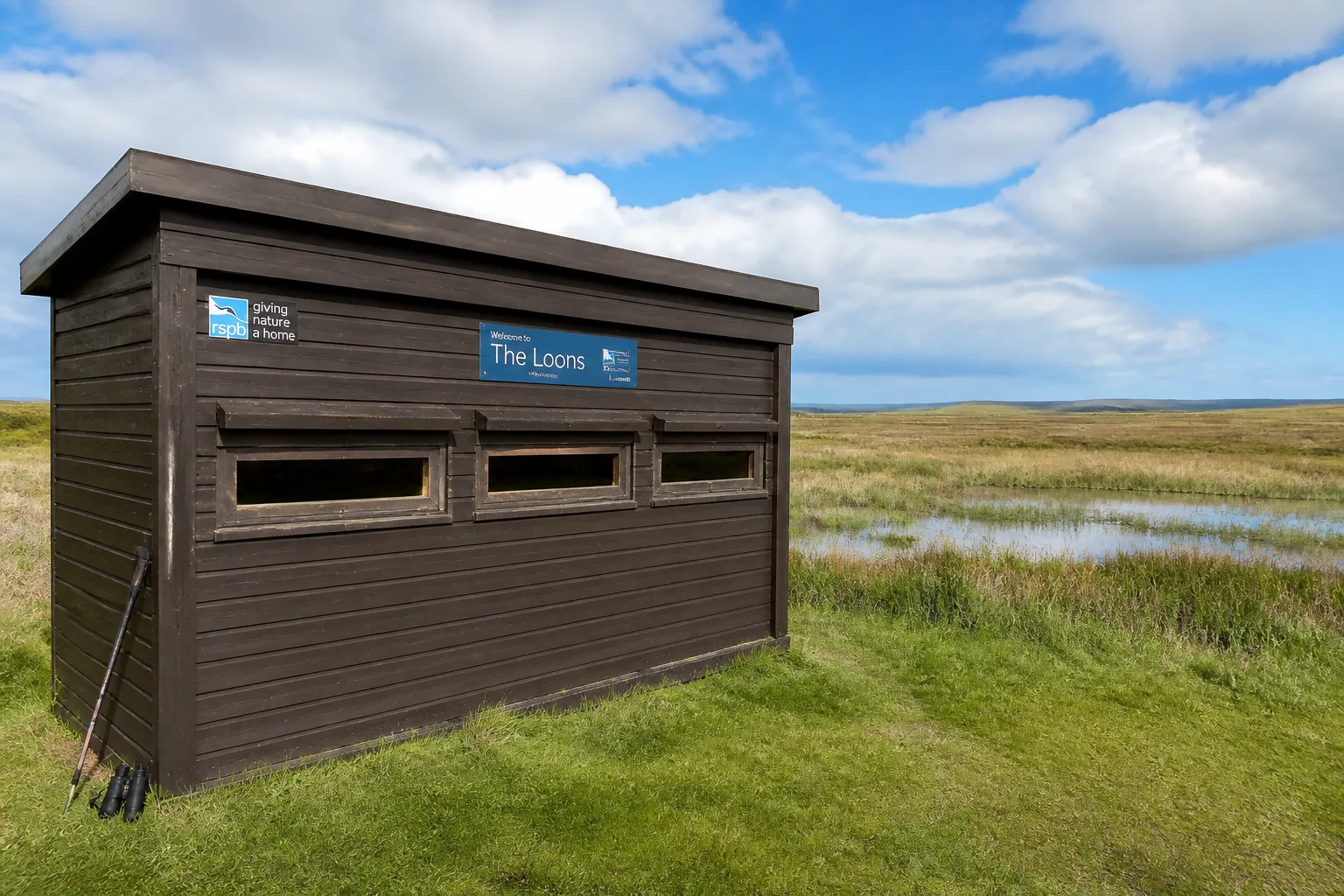
- RSPB The Loons & Loch of Banks (Mainland): Wetland reserve with hides including the famous "Listening Wall" for audible bird ID. Best for waders, ducks and summer warblers. Year-round, peak May–July.
- RSPB Cottascarth & Rendall Moss (Mainland): The harrier-watching hide — purpose-built for Hen Harriers and other moorland raptors. Best April–May for sky-dance.
- RSPB Birsay Moors (Mainland): Largest mainland moorland reserve. Hen Harriers, Merlin, Red-throated Diver. Roadside viewing possible.
- RSPB Burgar Hill (Mainland): Wooden hide over breeding-loch for Red-throated Diver. Peak May–June.
- Mull Head & The Gloup (Deerness, Mainland): Coastal reserve with dramatic cliffs, seabirds, and the collapsed sea-cave Gloup as a geological bonus.
- RSPB Hobbister (Mainland): Quieter moorland-and-coast reserve south of Kirkwall — good combined Hen Harrier and Short-eared Owl.
- Noup Cliffs (Westray): Gannets, Guillemots, Razorbills, Kittiwakes. Requires Orkney Ferries to Westray; walk from the lighthouse car park.
- North Hill (Papa Westray): 2,000+ pair Arctic Tern colony, Scottish Primrose, Arctic Skuas. Requires ferry/flight to Papa Westray.
- Castle o' Burrian (Westray): Orkney's biggest puffin colony — ~300 birds on the stack May–July.
- Trumland RSPB (Rousay): Short-eared Owl and moorland species; short ferry hop from Tingwall.
Planning the Visit — Best Months, Kit, and Etiquette
Most of the magic compresses into one ten-week window. Within that, micro-timing matters.
- Mid-May to mid-July: the absolute peak. Seabird cities at full volume, puffins ashore, terns on the cliffs, Short-eared Owls hunting through the long evenings, near-eighteen-hour daylight.
- Late March through May: the sky-dance window for Hen Harrier; Red-throated Diver courtship by mid-May. Fewer visitors, more weather risk.
- August: still good but tipping point — puffins gone by mid-month, terns following. Skuas still very active.
- November through February: wintering wildfowl and sea ducks. Quieter reserves, shorter days, very different mood.
Kit and etiquette
- Optics: 8x42 or 10x42 binoculars are the workhorse choice. A spotting scope is worth packing for distant Gannet plunge-dives and cliff-ledge counts.
- Timing: early morning and the last two hours before dusk are the most active windows for raptors and short-eared owls; tide times matter for waders on the bay edges.
- Tern defence: hold a stick above your head when walking through Arctic Tern colonies — they strike the highest point.
- Stay on paths: ground-nesting birds are a real risk during May–July; sticking to marked trails is non-negotiable.
- Dogs: on a lead, every reserve, every month, no exceptions. Particularly important April–August.
- Avian flu: do not touch sick or dead birds; report them to DEFRA on 03459 33 55 77. Current RSPB / NatureScot guidance applies.
If this is your first Orkney trip, line up the birding window against weather and ferry/flight realities by reading the complete first-timer's brief — best months, kit, and how to plan the ferry/flight connections. For the seal, whale and dolphin context that overlaps with the seabird season, the dedicated marine life guide covers what works the same water in summer.
Frequently Asked Questions
When is the best time to go birdwatching in Orkney?
Mid-May to mid-July is the peak window — seabird colonies at full pitch, puffins ashore on Castle o' Burrian and Marwick Head, Arctic Terns settled at North Hill on Papa Westray, near-eighteen-hour daylight. Late March through May is the prime Hen Harrier sky-dance window. November to February delivers a different programme: thousands of wintering Whooper Swans, Greylag Geese, Wigeon and sea ducks across the lochs and coastal bays.
Where are the best places to see puffins in Orkney?
Castle o' Burrian on Westray is Orkney's largest puffin colony — roughly 300 birds visible on and around the stack from late April to mid-August. Marwick Head on the Mainland is the most accessible site (short cliff walk from the car park, plus kittiwakes and guillemots in the same hour). The Brough of Birsay holds a smaller but very approachable colony — just time your visit around the tidal causeway.
How many Hen Harriers live in Orkney?
Orkney is one of three regional strongholds for Scotland's breeding Hen Harriers, alongside the west Highlands and the Hebrides. The 2023 RSPB national survey put Scotland at 529 territorial pairs (up 15% from 2016), and the Orkney Raptor Study Group confirmed Hen Harriers breeding in 74 locations in 2025 on the islands where stoats are present — the highest since 2012, driven by recovering Orkney vole numbers as the Orkney Native Wildlife Project's multi-year stoat eradication programme bites.
Is the Atlantic Puffin endangered?
The Atlantic Puffin is listed as Vulnerable on the IUCN Red List globally. Population declines are driven by climate-related changes in sand-eel availability, plastic ingestion, predator pressure on breeding islands and offshore industrial development. UK colonies have not declined uniformly — Orkney's stacks remain comparatively healthy, which is part of why Castle o' Burrian, Marwick Head and the Brough of Birsay matter as viewing sites.
How many RSPB reserves are there in Orkney?
Thirteen. The flagship sites for visitors are Marwick Head (seabird cliffs), The Loons (wetland with hides), Cottascarth & Rendall Moss (purpose-built harrier hide), Birsay Moors (largest moorland), Burgar Hill (Red-throated Diver hide), Noup Cliffs on Westray (gannets) and North Hill on Papa Westray (Arctic Terns). The others sit on Hoy, Rousay, Egilsay and the smaller North Isles.
Do I need to book or pay to visit Orkney's RSPB reserves?
No — all Orkney RSPB reserves are free-access open sites without ticket gates. Some have car parks; most have a single waymarked path. You will need to book ferry or air transfers separately to reach the island reserves on Westray, Papa Westray, Rousay and Hoy, and the Brough of Birsay causeway only opens at low tide. RSPB Orkney (Stromness office, 01856 850176) holds the current reserve information and any temporary closures for breeding-bird protection.
Orkney's birding offer is unusually compressed: three world-class seabird cities, a harrier population in recovery, a 2,000-pair Arctic Tern colony, and a free-access reserve network — all on a coastline you can drive in a day. Get the mid-May to mid-July window in your diary, sort a base from the full list of hotels, B&Bs and self-catering properties, pack the binoculars, and be ready to share the cliff edge with thousands of nesting neighbours.
Sources & further reading
The facts in this guide were checked against the following authoritative sources.
- RSPB Reserves in Orkney — RSPB Orkney reserve network
- World's Longest Migration — National Geographic — Arctic tern migration distance
- Orkney Stoat Project Boosts Hen Harriers — Perspective Media — hen harrier count 2025
- Gannet guide — Countryfile — Noup Cliffs 1,500 pairs, against Bass Rock 75,000 and Ailsa Craig 33,000
- VisitOrkney — Orkney wildlife overview